[ Content | Sidebar ]

Archives for painting

Post-Painting Depression

I’m back in Portland, Oregon, from my six-week Nevada sojourn. But I haven’t unpacked my big linen canvases yet. I am almost afraid to do so, fearing that they are completely banal, hence total failures (banality is worse for me than bad).

In part, this reluctance has to do with various coming home challenges — burst pipes, unreliable contractors, relatives using the house in unexpected and unnerving ways. But in part, it’s simply because I don’t know what I did, although I am fairly certain I did not manage to un-orient, and my feeble attempts merely feel like they may be so feeble as to look feeble-minded.

Well, you see where I am. I began last February and March, 2009, living with the desert and Beatty, Nevada, painting small masonite panels, getting to know the territory and its inhabitants. This November sojourn, however, was more limited and almost entirely devoted to the Amargosa, which became more and more fascinating as I spent 6-8 hours a day, alone with the scene, for the full month of November.

So here are photos of the seven panels, plus the full panorama. These were taken as the panels were still on the wall of the Red Barn, under under limited lighting conditions. The exception is the full panorama, which was lit andphotographed by professional photographer, David Lancaster.

I am showing these in part to bolster my own sense of dignity and/or bravado.

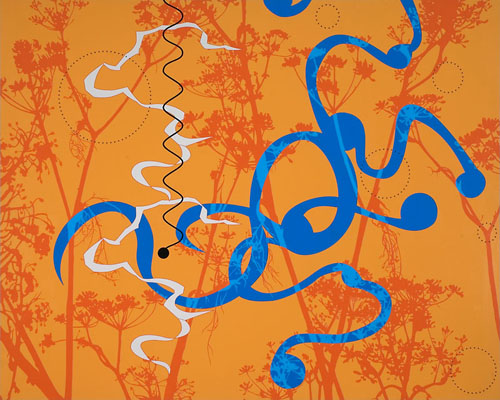
panel1WjouUnoriented Amargosa (panel 1, east), 4′ x 5′, oil on linen, 2009

more… »
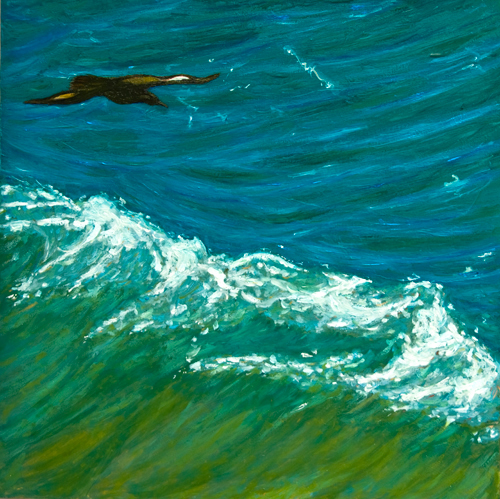
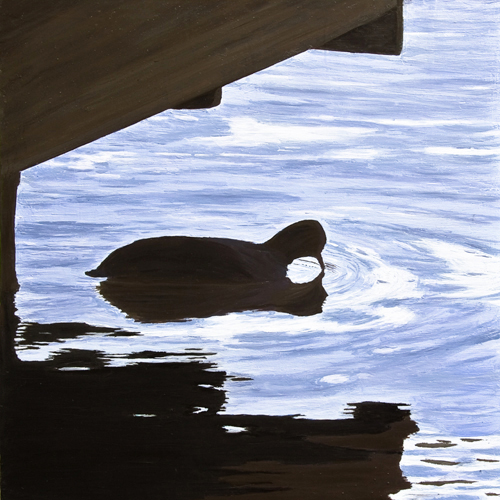
raven and water

ravenwave
12×12 inches, maple sized with wood glue, oil

Not only am I preoccupied with water, now there are also birds. Earlier, there were ducks, here and here; now, my first raven.

Color — some notions

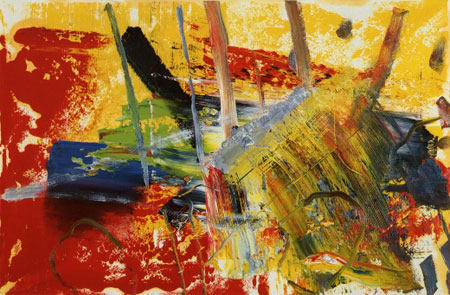
gerhardRichter86Oil

Gerhard Richter, 1985, 57.4 cm x 86.4 cm, Oil on paper

The Henri Art Magazine (written, I think, by several authors) has a fascinating continuation of a discussion of color, “Color: Simulation,” published on Wednesday Nov. 4, 2009.

The author discusses how the perception of color has changed with technology, the technology that presents any color you want: directly out of the can (reducing the need to use traditional techniques to create luminescence or brilliance by direct observation and experience); and then, further “enhancing” and changing color as we know it, technology can produce a pure physics of color through light technologies (as seen on the computer screen.) This, he insists, has produced color as desire, as consumer directed, and loses color as personal and emotive.

I can’t do justice to the writer’s observations; you’ll need to read them yourself. And I’m not sure the polemic need be as strong as it is.

But I was reminded of Steve’s black and white photography, (also here, on A&P) and along with thinking that Steve’s work clearly transcends point-and-shoot photography of the digitized masses, I suddenly understood how the black and white refuses the seduction of the digitized web versions of color.

more… »

reflecting

reflection
oil on a maple, 12 x 12 inches

A meditating duck in the Banter Lake outside Liselotte’s cabin in Wilhelmshaven.

The color that I chose for painting water in Northern Germany differs from my usual Lake Michigan color mix. Today, it consists of Ultramarine Blue, Dioxane violet, Titanium White and Zinc White.

I paint water, June paints the desert. Do you also have a proclivity for a particular motif or theme?

Orientation

travelSnowyRoad

more… »

Commission’s love, to be or not…

It wasn’t until mid Renaissance times that anyone other than the church was wealthy enough to afford decorative commissioned paintings. People wanted to show their wealth by asking painters and sculptors to do this.
Roman Art was almost as wallpaper, it covered most of the interior walls, outdoors murals, shop walls and ceilings.
Art form then, was a service to others, a technical skill brought into your establishment with limited individual freedom. Nevertheless, many artists while working for the church and patrons would also benefit from food and bedding as guests while executing their assignments.
In contemporary times, artists are given an assignment and we often pre-negotiate payment, theme, color scheme, size, etc…
Has the artist possess limited freedom in their work? What are the personal benefits besides the payment that an artist accomplishes from a commission that moves away from the individual style?
The challenge is that an artist has to re-think their work outside their ‘safe-comfort zone’ and create pieces that satisfy the commissioner as much as themselves.
I personally found this a very enjoyable journey for a professional artist. These five paintings shown here are an allocated comission to Novotel Hotel in my local zone.
After given a brief, I have walked to my studio thinking, researched and re-invent some artform that would still fall in to the client’s expectation and of course carry on my style signature. A challenge that I have truly enjoyed with the added bonus of discovering a new facet to my developing art skills.
Is a traditional artist an ego seeker? What is an artist true goal when producing art, is it their own fulfillment, or is it the rewarding enjoyment of public/patrons approval?

Sloppy Craft: It’s Getting Interesting….

The phrase, “Sloppy Craft”, the title of a recent panel discussion and a forthcoming exhibition at Portland’s Contemporary Crafts Museum, had to be checked out. Whatever could it mean? How could the Contemporary Crafts Museum have been drawn into featuring sloppiness? What kind of provocation was intended by the title? What are the implications of honoring such a concept as sloppy craft for art as well as craft?  Tell me more, tell me more.

A bit of background: when I was working textiles, I regularly engaged in a “discussion” with quilters (some traditional, some contemporary) about whether the stitching work done on my textiles ( specifically in construction and quilting) should strive for perfection. I always maintained that my goal was “competence.” My attention was entirely on the image and impact (on, I maintained, the art).  The craft was there only to hold it together and/or to add to the art. Hence my seams were not necessarily straight and the back of the art was decent but not flawless (I didn’t bury my threads, for example, simply tidied them). I used the quilting stitches as part of the design, which meant that they were generally not even in length and that they were heavy in places and light in others; this can make the quilted art hang wonkily, requiring heroic measures to make it perform well.

This is an example of a old piece of mine that I claim has “competent” craft:

SophieEmergingwSophie, Emerging, 84 x 73″, 2002, Materials: hand-painted cotton, canvas, silk, stretch-polyester, felt. Methods: hand- painted-and-dyed, airbrushed and commercial fabrics. Machine stitched.

more… »