Posted by Sunil Gangadharan on March 8th, 2007
I have often found it difficult to frame a message by just painting a face. A lot of people ask me ‘OK, who is this – rather than – what are you trying to say by painting this face..’. Sometimes the title tends to reinforce the painting but few today tend to dwell on titles.
I got thinking about this more a couple of days back as I was reading a review in the New York Times about an exhibition “Citizens and Kings: Portraits in the Age of Revolution, 1760-1830” (underway at the Royal Academy of Arts in London, England). The portraits at the show tended to focus on the ‘message’ rather than the medium, movement or technique (as opposed to the majority of shows today which tend to focus on one or more of the latter). The article also made a reference to the fact that over time, the message tends to fade away while the techniques and talent employed in creating the work live on. While it is commendable that technique and talent stand the test of time (and should), exhibitions like these are relevant in showcasing the effects of social situations on paintings and how painters were influenced symbioticallyby the social milieu ultimately chronicling the society they lived in.
From the article in the NYT (I somehow got to it, but it might ask for a subscription):
“Yet this exhibition’s purpose is radically different: it is to dwell on the message, not the medium. Rather than celebrating the artists as such, it presents them as witnesses to the social and political convulsions of their times. It shows them recording a crucial moment of history as it unfolded.”
What does this painting tell you?
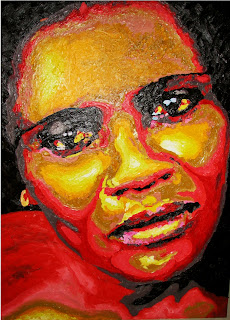
I am interested in your response before you look for my interpretation here.
Posted by Doug Plummer on March 6th, 2007
I was planning on posting this anyway, apropos of leaving on vacation with my wife, Robin, today. Then I saw Steve Durbin’s entry, and realized it would be the perfect follow-up. It’s a piece she wrote for my blog last year, but I think only 30 people saw it at the time. Her advice deserves a wider audience.
Advice to photographers’ significant others:
- When on a shoot or on the road, always bring food, water, and a book. If the light becomes “perfect” (usually early or late in the day, or if it’s overcast in just the right way), your photog will be captivated by it. Do insist on your right to go to the bathroom, be dropped at the hotel before the light comes in, or have your basic needs taken care of.
- Don’t take it personally when he says, “The light is beautiful on you.” You could be a rock, or a stump, or a wall. But he probably loves you anyway.
- Don’t take it personally when you become the “foreground element”. It’s not about you. You’re just the one that’s there.
- Do take it personally, in the best way, if you become the object of many studies. Photographers connect with the world through their cameras. It is another way of being known.
- You don’t have to like all of the work, if you like the photographer. Doug has one body of work that is too visually complex for my brain to process. None of this work is in the living room. If your person needs you to love every picture, send him to therapy. If you think you need to love every picture, go yourself.
- Get used to schedule changes. Your photog might find out on Tuesday that he’s going to Ireland for two weeks on Thursday. Have friends to fill in the gap. Accommodations I figured out included putting in a watering system for the garden, hiring people to do some of his tasks, and letting myself be pissed about the changes, until I’m not.
- Keep in contact. In most places in the developed world, there are local cell phones for sale. Speak often. Email. Whine. Say endearments. Listen to whining. Support. Ask for support. It’s good glue. We talk almost every day. I especially like to bask in Doug’s excitement when he’s on a shoot and it’s going well. He does bliss well.
- It’s okay to demand that the geek speak stops, when you’ve run out of patience for it. Especially if they’re talking about digital workflows. It’s rude for people to speak in a language not shared by others.
- When he comes back into town with 4,000 images to process, make some dates to connect, but don’t expect that he’ll be fully there until the images are on a disc and sent away. Then you can have the coming-back fight and really connect.
- It’s OK to play the wife role, whatever your gender, on occasion. I do this at openings and print sales and during the big post-shoot image processing. Other times, be who you are, more than wife. Doug is the wife at my conferences and book signings and when I’m writing. It’s OK to be flexible. Don’t get caught up in the role. It’s not a full enough identity for anyone.
- If you’re traveling together, don’t think you have to be joined at the hip. Pursue your own interests, then meet later. Do ask your person to leave the camera in the room or in the bag for a meal or an evening. Suggesting that making contact with you might allow your photog to “get lucky” can help this occur. It works for me.
- If he’s been gone for a long time, and you’ve had the house to yourself, expect conflict on re-entry. It’s normal. It’s predictable. Just have it. He’s invading your space, after all.
- Dont worry about the “Bridges of Madison County” scenario. You know how he really is.
- A story: Several years ago, outside of Banff, after a full day of shooting, the light changed and Doug became enchanted. I was really hungry. After 45 minutes, I demanded to be driven into town for food. Reluctantly, Doug packed up his gear, and we drove to a 2nd-floor sushi bar. I was facing the window. The light was magical. We ordered anyway. Before the fish came, I saw a rainbow over Mount Rundle. I said, “Doug, get your gear and get out there.” He did. 20 minutes later he returned. Three minutes later, the second rainbow appeared, arcing over the other. “Get back out there, now!” The waiter didn’t know what was going on. He kept asking if everything was alright. He didn’t understand my explanation: “My husband is a photographer.”
Robin’s blog (on therapy issues, for other therapists–you think photographer’s use geekspeak?) is at Trauma & Attachment.
Posted by Steve Durbin on March 6th, 2007
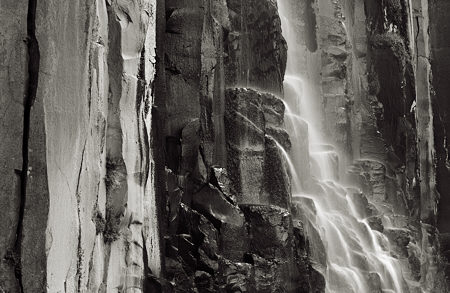
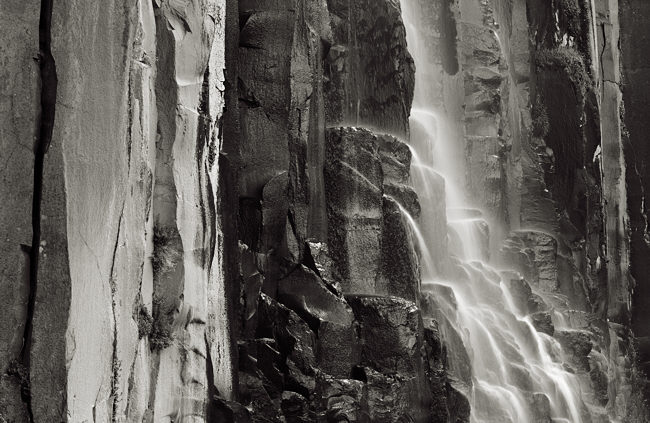
My landscape photography has grown out of activities I would engage in anyway. I’ve always loved hiking, be it in the mountains, the woods, the desert — anywhere. These days I usually have my camera along. Sometimes I’ll be in an area I suspect might be interesting photographically, but usually I’m just in a place I want to explore. Either way, I don’t feel cheated if I take no pictures at all, and I’ve never had a bad time. But I have found a difference between productive and unproductive outings. The key predictor is whether I’m alone.
more… »
Posted by Karl Zipser on March 5th, 2007
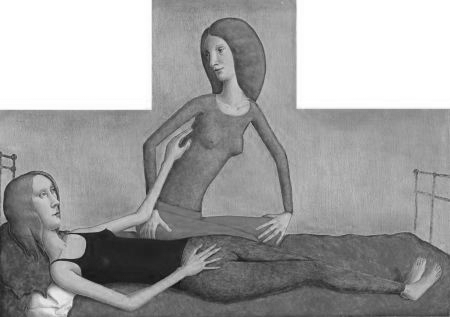
Following the intuition that I am seeking some type of understanding — this for me is the basis of being an artist. Introspection tells me that painting is not about making a statement; rather, it is something closer to asking a question.
The feeling that a painting can be the basis for a discovery is what makes it to me worthwhile. I think it is this feeling which motivates me during the process of working and maintains my attention when the work is complete. Then I can ask, where did this image come from? What does it mean?
Posted by Richard Rothstein on March 4th, 2007
I’ve recently taken to carrying my Canon Elph around during some of my late night prowling. Among other things, I’m fascinated by the interesting results you can achieve with a simple digital camera in the absence of light and minus the flash. Actually, while I may successfully frame a shot in almost complete darkness, it isn’t until I get home and load the photos on my computer that I discover many of the interesting details. In fact, I’m often delighted and surprised by the results, revealing scenes that my naked eye failed to see. Sometimes the effects are ghostly and othertimes quite erotic (at least to a queer eye.)


more… »
Posted by Steve Durbin on March 2nd, 2007
David Palmer’s show at the William Turner Gallery in Santa Monica opened last weekend. I’ve been intrigued by David’s work since I first saw it on his web site, and I’d been pestering him for an interview, which we finally did by email. I found it a fascinating view into the ideas and materials and process of David’s art making. It came out long, but it’s all good stuff. Just cowboy up and read it!
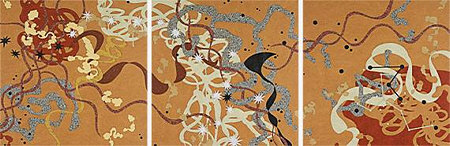
Major Motion Picture (Forever Almost Falling, 2006)
more… »
Posted by Sunil Gangadharan on March 1st, 2007
I was recently reading a book by neuroscientist V.S. Ramachandran where he argues that Chola bronzes from ancient India were mocked at by the Victorian Englishmen as artistically primitive and unrealistic. They were unrealistic in the sense that the waist was too narrow, hips too wide and their breasts too large. They in fact decided that art like this was not art at all and labeled it primitive art. Professor Ramachandran goes on to say that some of the Victorians labeled the art thus based on prevailing standards of Western art (some of which was rooted in realism and stemmed from classical Greek and Renaissance art).
more… »