[ Content | Sidebar ]

Archives for 2007

Children’s art, in the perception of the observer [UPDATE 2]

what.jpg

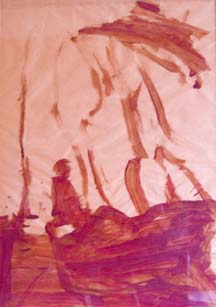
Red gauche on paper

Let’s for a moment accept the proposition that children artists can be considered “real artists.” What an odd type of artist a child makes, if you think about it. What a short career a child has as an artist, always in transition. Who could be worse at writing an artist’s statement than a child?

Please look at the painting above and ask yourself, what does it depict? I have looked at this artwork many times and I always have had more or less the same interpretation of the content. But what was the artist’s intention? Are our views similar? Why don’t I ask the artist? In fact, I am the artist. I painted this sometime during the early 1970’s, but I have no memory of doing so. I have no idea what I intended. I somehow doubt that my interpretation of the picture (which I remember from later in my childhood) is in fact what I was thinking when I painted it.

The painting is framed behind glass, which makes it difficult to photograph. My mother made frames for many of my sister’s and my artworks, without which they would certainly have been lost. Children’s art was the main artwork in our house when I was growing up. If it were not for this early encouragement, I probably would not have become an artist.

Do you frame your children’s art? Do you ever think of the long-term implications of doing so (or not doing so)?

. . .

[Update]
I enjoyed reading the different interpretations of this painting by Sunil, Steve, Rex, Leslie, June, and Birgit. I never had the idea of a giant figure on the right before, but Sunil’s comment made me look at the picture in a different way. An area of agreement is that the picture shows a man. I would really like to know what I thought I was doing when I made this.

I’ve been thinking about this picture a lot, about the role of the “artist.” Here is what I think: my mother’s role in this picture was something like that of a photographer. She didn’t “make” the image by hand, but she created the conditions for it to be made. Presumably it was one of many paintings. She selected this one, framed it and saved it. I think she chose this image for a reason, because it is a compelling. She could also have made a compelling photograph of a pattern of clouds in the sky that looked a lot like a man on a dock or a boat, or what have you. I think my role as a three or four year old painter is completely accidental.

Is children’s art art? It seems to me that it can be, but a parent or some adult has an important role to play in making it art — selecting what is good and presenting it as art.

[UPDATE 2]
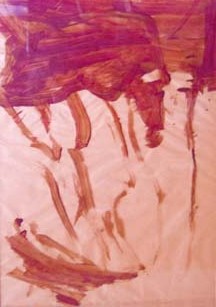
what-rotated.jpg

Hot and Cold

Things are pretty quiet around here culture-wise, given the lack of college students (and perhaps the long-awaited onset of winter weather). So perhaps I can be forgiven for my lack of posting. But I have been thinking about art-criticism in the abstract, raising some questions that ought to be of practical relevance to my own activity as a semi-serious art-critic and blogger. So I’d like to initiate a series of posts on the subject.

A while back, I had a brief exchange with Franklin of Artblog.net, who announced that he was quitting art-criticism, in large part because of its perceived incompatibility with being an artist. As he wrote, “They’re contradictory exercises, professionally and temperamentally.” In response to my request for clarification, he responded:

Petty hatreds and unjustifiable loves that are unbecoming in a critic are a necessary part of an artist’s inclinations. I’ll continue to criticize to the extent that it helps me think about art, but I am stepping out of the role of capital-C Critic, and the title’s implications of fair-mindedness and responsibility. I relinquish efforts to make my writing strive for either. As a critic, that wouldn’t be right. As an artist, it’s fine.

This seems like a reasonable position and it appears to be widespread conventional wisdom. Yet I had some reservations, and so I responded:

I think they’re unbecoming if you put them up front and in the center. Indeed, a Critic should strive to be open-minded and go beyond idiosyncratic likes and dislikes. But it also seems disingenuous to me to pretend that criticism is a wholly neutral, disinterested affair. The critic is a judge, but also somebody who takes genuine pleasure (or displeasure) in artworks, just like anybody else. So it seems like there should be a middle ground, a way of letting two voices speak.

I have little to add to this impromptu “theory” at the moment, but I would like to illustrate what I take to be the difference between an enthusiastic review and a cool-headed, dispassionate one. For the former category, I’ll submit for your attention this piece I wrote about Boston painter (and former teacher of mine) Gerry Bergstein. For the latter, here is a piece I wrote about recently deceased Ithaca painter John Hartell. Both are nominally “positive” reviews, with regards to most of the work, if not to certain curatorial decisions. Both contain level-headed analysis and interpretation. But I think something of my differing enthusiasms comes through in the writing.

As one of only a handful of local individuals writing criticism of the visual arts, I believe that it is my ethical responsibility to cover as wide a variety of subjects as I am competent to cover. (In my newspaper writing, not so much in my blogging.) And I believe that it is important to be fair and balanced in doing so. But to try and repress my “petty hatreds and unjustifiable loves” entirely suggests to me an alienated approach to arts, one foreign not just to most artists, but to most amateur enthusiasts. Actually, I am willing to repress the hatreds; the loves however should be allowed to bubble to the surface once in a while. At least that’s the idea.

Purple grapes (continued)

purple-grape-scan450b.jpg

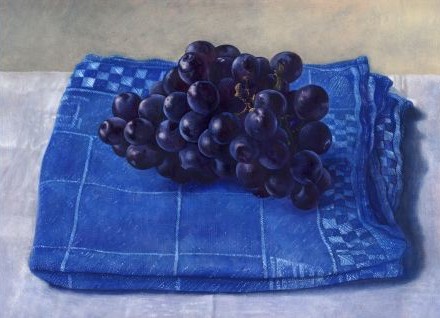
I’ve gone further with this painting (which we saw at earlier stages before). I’ve been thinking a lot about your suggestions from last time while I was painting. What do I need to do to finish the picture? Any suggestions? For reference, the cloth is about 25 cm wide at its widest point. Here are some details of the picture: more… »

Quark’s rabbit

Quark's rabbit

Probably every cat owner has encountered a scene like this on the garden path, or maybe even on the living room rug. When I came across it one morning, I immediately went for my camera and tripod. I felt slightly odd about it, but there was, after all, nothing I could do for the rabbit at that point. There is a long tradition of photographing dead subjects, and almost a genre of roadkill snapshots. Edward Weston once even photographed a dead man he happened on in the California desert. Nevertheless, presenting the result as art, for example by hanging it on a wall or in a gallery, could be considered tacky or provocative or risky. Much, of course, depends on the audience. What do you think of this picture? And is there subject matter that is unlikely to make good art?

What do artists want in a website?


plein air landscape painting
Painting From Life vs. From Photos


If you are an artist, what kind of website do you want to have for your own use?

As an artist:

I think many artists would like to have some kind of combination of these (unrelated) things. The problem is that the off-the-shelf solutions such as WordPress or Blogger are not designed for artists’ needs. That is why a lot of us spend/waste a lot of time tinkering with our websites, to customize them for our specific goals.

Recently Rex brought something exciting to my attention, a new version of WordPress that allows one to host many blogs. That is to say, if someone designs a good artist website template, they can allow other people to create their own blogs with this template on demand, for free — much like you can already get a WordPress blog for free.

To be useful for many artists, such a system should address the various issues that artists consider in a website.

What do you want in an artist website? Can you give examples of sites that have good design features?

Multi-blogging using WordPress Categories [Updated]

zipsernldetail2.jpg

I think that using Categories is key to working with WordPress blogs. By using Categories (for example, drawing, painting, photography, the art world) it becomes possible to turn a single blog into a multi-blog.

This lets me turn my tagline on zipser.nl into a functional tagline. It is not only a description of the blog, but a set of links to the content of the separate categories. The basic form is inspired by Edward Winkleman’s tagline. [Steve Durbin also has a functional tagline much like the one I describe here.]
Arthur Whitman suggested that a blog is like a home; different sections (Categories perhaps?) could be like rooms. I think the metaphor is powerful, but I don’t feel quite, well, at home with it yet.

Any suggestions as to how to take Arthur’s idea further?

UPDATE . . .

more… »

Ambition

“The greater danger is not that our aim is too high and we miss it, but that it is too low and we reach it.”

Michelangelo

Just recently we had some discussion of New Year’s Resolutions. One of mine had to do with achieving some body sculpting goals. To accomplish that, I put myself on training regimen, but very soon, I noticed, “Well, I’ve done this before, and I’ve never achieved the kind of results I’m after. What’s it gonna take? What’s it really gonna take?”

So I started doing some research. I began with the knowledge that though I’ve been a jock pretty much my whole life, maybe, just maybe I did not know just exactly how to get “ripped,” and sure enough, I found that I had more than a thing or two to learn about reducing fat while increasing muscle. In fact, it was on a little motivational excerpt from one of my resources that I got the above quote.
more… »

css.php