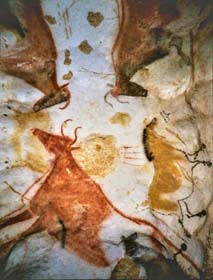
David Lewis-Williams in The Mind in the Cave and Inside the Neolithic Mind postulates that religion has its origins in hard-wired brain functions he calls “states of altered consciousness.” Among these altered states are the hypnogogic (just prior to and awakening from sleep) as well as states induced by consciously chosen activities, for example, rhythmic dancing, meditation, and persistent highly rhythmical sound patterns. And then there are the other well-known states, whether chosen or inflicted, that alter consciousness — ingestion of psychotropic substances, intense concentration, fatigue, hunger, sensory deprivation, extreme pain, migraine, temporal lobe epilepsy, hyperventilation, electrical stimulation, near-death experiences, and schizophrenia and other pathological conditions (Inside the Neolithic Mind, page 46).
These states of consciousness, combined with homo sapiens’ ability to remember the visions that occur in such states, says Lewis-Williams, account for the rise of religion, some social organizations (primarily religious hierarchies), and the early paintings and art found in western Europe at places like the caves of Lascaux well as in the Near East around the upper reaches of the Tigris-Euphrates, Jordan, and Turkey.
The Mind in the Cave has as its sub-title, Consciousness and the Origin of Art, and while I’m not equipped to evaluate either the neurology nor Lewis-Williams’ archaeological arguments, what he describes as a hard-wired state of the human brain which leads to art (my words) seems valid to me.
It has long been part understood that altered consciousness evokes visions that are used to make art. Think of Coleridge’s Kubla Khan (”A damsel with a dulcimer/ In a vision once I saw”), reportedly a result of an opium dream. Or Wordsworth’s “sense sublime” in Tintern Abbey whose “affections gently lead us on,/ Until the breath of this corporeal frame/ And even the motion of our human blood/ Almost suspended, we are laid asleep/ In body, and become a living soul:/ While with an eye made quiet by the power/Of harmony, and the deep power of joy,/ We see into the life of things.”
What occurs to me (and granted it’s a pretty old thought, dressed up by recent neurological research) is that artists, like masters of meditation, are able to achieve an altered state readily, without “artificial” stimuli or illness. They seem to be able to achieve these states more easily than others in our rational, conscious-brain-oriented society. On A&P we talk about being “in the zone” or not noticing the passage of time while we are working. We see things differently because we’re talking and looking at art, as Birgit did on her walk after Steve’s post on quotes from O’Keefe. Sunil talked of living the life of art. I noticed that sometimes I see differently when I’m casually photographing.
We use specific activities or objects as triggers to that altered state, which might be why Karl and I are neither self-indulgent nor masochistic when we work outside. We can obtain some condition of mind that is conducive to our art work; we find our “sense sublime.”
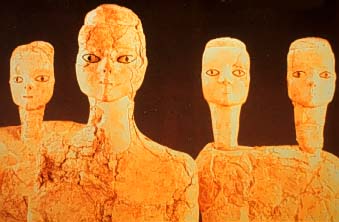
It’s this old knowledge, now validated by science, which provides not only a reason homo sapiens are religiously inclined, but, more important to this group, that art might be a specific function of those altered states. With that knowledge, it’s possible to gain credibility for the importance of artmaking to the whole of civilization. Lewis-Williams says that the earliest “artists,” particularly those who depicted clay figures and skulls with predominant eyes (I keep thinking of Emerson’s “Transparent Eyeball”), were not among the elite shamans and high priests of an organized religion, but rather ordinary people expressing what they saw in their day dreams or fatigue or hunger.
Lewis-Williams isn’t sure he approves of such states of altered consciousness, even though he says they have produced Bach, John Donne, Shakespeare, and other great artists. He says: “The exaltation that those great creators excite in us does not justify mystical atavism. Shamanism and visions of a bizarre spirit realm may have worked in hunter-gatherer communities and even have produced great art; it does not follow that they will work in the present-day world or that we should today believe in personal spirit guides and subterranean worlds. We can catch our breath when we walk into the Hall of the Bulls without wishing to recapture and submit to the religious beliefs and regimen that produced them.” (p 291, The Mind in the Cave)
I guess my question for the day is, am I out in la-la land, imagining that we might ally our rational brains with our (irrational) altered consciousnesses (without necessarily adding any specific religion to the mix) and in doing so enhance our abilities to produce art? And might this become not be only broadly acceptable, but a democratizing of the artistic impulse, rendering it more accessible to everyone? In some ways the DIY movement, the democratizing of art, could be seen as a way into this understanding, giving people a greater knowledge of the mental state out of which “visions” arise. Lewis-Williams says that the earliest altered consciousnesses that we have physical evidence of are the most “democratic,” non-hierarchical. This seems to fit into a DIY world, where it isn’t just the artistic elite among us who can vision and produce art.
I also might venture to ask if this alliance might not actually be a necessary piece of the human condition, and if it were to become part of our greater knowledge,we might make greater intentional use of it. We might move away from sectarian religious upheavals without losing the sense and usefulness of what sometimes is called spirituality. The irrational can be understood as hard-wired into us and turned to good ends, without falling into superstition or la-la land.
And as a side-note, which may or may not illuminate — I have been wont to say that theories of Gaia are really just sentimental foolishnesses, and that Ma Earth will get along quite fine without homo sapiens. She really doesn’t care what we do to her — she’ll just keep rolling along. On the other hand, in my irrational states of altered consciousness, I’m a Cenozoic patriot, and even though I rationally know that in the long run of geological history, what we do doesn’t much matter much at all, my irrational mind insists that the rational information doesn’t much matter. Something outside my rational mind insists that I care for the environment, even if the environment doesn’t give a damn. Not a bad use of an vision from an altered consciousness.

Hi June, I’m processing your post…
Me too. I started googling meditation, thicker cortical layers, serotonin, self-transcendence etc.
Last year, I read a neat explanation for the near death experience in a Zuerich daily. A local neurologist suggested that the white brilliance that people see is due to oxygen deprivation depolarizing visual neurons, making them all fire at the same time.
Finally, we have a bright blue sky. Be back later after my daily photography.
June:
Good post. I’m sure this will hit fifty comments.
This isn’t so much which end of the stick to pick up, but which branch of the spreading oak to grab.
Regards religion, the power of the altered state is important, but I doubt if visions and out-of-body experiences themselves define religion. Billions of Chinese have been raised in Taoist surroundings with nary a reference to such goings on. I grew up as an Orthodox Presbyterian and it became evident to me from a young age that whatever fervency I saw was somebody busy trying to dodge a bullet from Hell. The punishment/reward duality reigned supreme and folks hunkered down.
Tried a toke when younger, but I didn’t inhale. Yet without performance-enhancing drugs I do occasionally have epiphanies. These can happen when I’m alone on the road, going through the turnpike tunnels with Men At Work cranked up. Or staring at a table top during parents/teachers night and having the surface dissolve into a dimensionless void in which unattached parts of me feel like they’re floating. That kind of thing. But I have found that such experiences do not translate into static art - except for those moments when I awake in the morning.
Speaking of “the zone”, I wonder if that isn’t often a dropping-away of peripheral awareness as the population of the mind collectively plops down with some chips and a beer to watch the hands at work.
Wow, this is a great topic for revealing all our un- or semi-substantiated beliefs. Which is good, of course. A few of mine:
1. I believe in the different mental states that can be induced in various ways.
2. I see religion as driven by a need to explain things that seem unfathomable. Sure, these could be visions, but isn’t the “normal” world of Birgit’s blue sky, etc. unfathomable enough to the pre-scientific mind?
3. There may be something to artists being able to use or even alter their mental states, but what about the drawings of children, whether representational or imaginary? I think of such activities as at the origin of art for an individual (at least they could be). Are these children accessing altered states? As for religion, I wonder if “real” world isn’t enough of a stimulus already.
4. Even if altered states are not necessary for art or religion, they could certainly enhance the experience, and, in the case of art, the resulting product.
June,
I’ve been thinking about your recent “nature is art” post and it occurred to me that something like an altered state gave you the impression that everything you saw is art. What was really going on I suspect is that your mind was in super-art mode, a good place to be.
As to the larger issue of democratizing art and moving away from sectarian religious upheavals, I haven’t been thinking about the issue at that level before. I’ll have to ponder a bit . . .
My knee jerk reaction is to ask what predisposes people to magical experiences. So far, no one knows.
A Swedish group proposed that the serotonergic system is a sensory filter based on their finding that ‘spiritually accepting’ men were shown to have less serotonergic receptors (a weaker filter) in their brains than more ‘rational’ men. But, as was pointed out, another explanation for their finding is that spiritually accepting people have increased serotonergic transmission that, by homeostatic feedback, leads to a reduced receptor population. Another unresolved question is whether schizophrenia involves pathology of the dopaminergic system or whether there is a reduction in glutaminergic receptors that throws the brain out of balance? What is the chance that a newly established ‘Psychiatric Genomic Center’ will succeed in its the 10-yr deadline of diagnosing psychiatric disorders based on DNA sequences?
Rather than thinking more about mood, spirituality, magical experiences and brain function, this week I will continue to engage in my pagan pleasures – contemplating the energy of a tree, a body of water, a raven.
Birgit:
I agree.
Hi all,
I’m coming to AandP after a long exhausting day, so I may be even more unclear than usual.
I think I initially found Lewis-Williams exciting because he seemed to be on to a new answer to the question of “why religion?”
I’m not at all religious, being very much a part of a materialist/scientific bent, and I have always found it puzzling that religion could be the force it is for so many intelligent people I know. If, as I had thought and Steve mentions, religion came from unexplained forces of nature, it should have diminished greatly since the Renaissance. Since that isn’t the case, I was drawn to Lewis-Williams postulating that altered consciousness states retain their strength through brain hard-wiring and yet are unaccounted for by a materialist viewpoint.
I got more interested when it occurred to me that the connection between religion and art was not that some god or spiritual being who magically causes our fingers to draw things (ala Byzantine icons), but rather that the sensations that bring people to religion could have the same root as the sensations that bring people to art.So they have been, over the centuries, conflated in people’s minds.
I’m a bit skeptical about Lewis-Williams’ glomming of all kinds of altered states of consciousness together (in other words, if I’m following Birgit correctly, I’m agreeing with her), but that wasn’t his area of expertise or even his point. I had extracted that list because I saw that out of my own experiences — meditation, extreme concentration, fatigue, stress — has come some art that feels to me like it taps into power that I didn’t know I had.
I have long understood that the unconscious works in mysterious ways. I set up problems just before I go to bed so my brain can work on them during the night. I look at my art in varied lights, finding that twilight and the end of a long day can show me things I didn’t know were in it. So it doesn’t surprise me that it’s possible that there is more than just the conscious and the unconscious. I would like to understand the altered state of consciousness better so I can tap into it more readily.
Birgit, I’m glad you have blue sky and pagan pleasures — long may they resonate.
Jay, I think taoism is really strongly into altered states; confucianism is the eastern religion that I would have thought relied on rationality.
Steve, I think indeed that children have fewer boundaries between the rational and the visionary, which I’m equating with the state of altered consciousness. So they are tapping into that state, without being aware of it. In fact, good ol’ Wordsworth talks of the “glory and the dream” in his poem about feeling one with the universe when, as a boy, he was ice skating on a winter’s evening.
karl, I like “super-art mode” — it’s a good substitute for the awkward and misleading “altered state of consciousness.” Alas it would lose the non-artists, with whom I am thinking we could make an alliance.
And Birgit, I think you are right that no one knows “what predisposes people to magical experiences.” But L-W’s theory, along with some of the allusions to scientific studies of the last few years might get us a bit further along in sussing out something more useful for me. More useful, I mean than to appealing to my spirit guide (crows, not ravens) to take me to a world from whence I could bring back inspired art (herein insert “snort”)
Now I must quit for the night for I see that I’ve outstayed my brain. I’m off to a state of altered consciousness, hypnogogic in nature. (ain’t it cool to learn new words and use them on your friends?)
Birgit:
contemplating the energy of a tree, a body of water, a raven.
One of my favorite ways to contemplate the energy of a tree is around a campfire as the tree warmly disentangles itself. In fact, I sometimes enter a reverie, as have my predecessors. I have to believe that people, sheltered in a cave and watching the flickering shadows of the fire on the walls and ceiling - and perhaps not entirely understanding of the mechanics of light and shadow - imagined dancing ghosts, come to be with them. Mystical and very conducive to expression.
June:
You’re absolutely right - Confucianism. But, in the interests of measuring the extent of my error, I took a look at Taoism. I should be more careful in throwing terms about, but in this case I may have stumbled upon something. From what I could gather, Taoism is about balance, peace, centering. Makes me wonder if we might find here a settled reference point against which to compare altered states.
I always thought there was a huge difference between religion and spirituality. To me, religion includes routines and beliefs that are rarely questioned. Religion can be used to control whole societies and can be an effective way to divide people into groups with one thinking they are better than the other. All very human characteristics.
Spirituality is a much more personal exploration of the greater questions in life, and even the smaller ones. It’s not about being right or wrong, it’s just about being present and accepting of the moment we call Now. All very human characteristics, too.
Yet both of these bring about the idea of “altered consciousness.” I’m not so sure I like that idea because to me it implies a division within ourselves.
If it comes from your consciousness which is a whole, how is it altered? Is it altered because we as humans feel we must control everything and therefore fear things that may not fit into our concept of “normal?”
I believe our consciousness is vast and most humans will never tap into all it knows. And when we have experiences that seem to us outside of the norm, often we think it’s from an outside power greater than ourselves. I think this is the most tragic thing of all, to not realize we are the greatest power.
I think a good example is the experience of Kundalini which comes from the Hindu tradition but has been universally recorded in other religious traditions (and outside of them). It is considered an Awakening, a spiritual experience that is completely transformative. In the Hindu tradition, it is described as a snake coiled three and a half times around the base of the spine and when activated, the snake rises up the spine to the brain. There is also the correlation to Shiva and Shakti.
Kundalini symptoms have been confused with mental illness and can cause psychosis. It can also be incredibly blissful and wonderful.
The thing is, there are specific physiological aspects to Kundalini and the process can be broken down into scientific terms. I would argue then that this is a wonderful example of science and “irrational” thinking coming together.
However one views this experience, as the Holy Spirit, God, as the activation of chakras and/or gods and goddesses dancing within you, it is also based solidly on the workings of the body and mind.
Many who have experienced this are very creative people, who turn to poetry and painting and other creative means to share their experiences with others as well as make sense of it for themselves. Yet some may say this creativity comes from outside of themselves. I suppose it’s a complicated issue.
I recently watched the PBS show from 2005 on American Art. “Destruction of nature is part of nature.” I believe that was said during the segment on Robert Smithson.
Well, I guess if I were to compare myself to what you’ve written here June, I’m a highly irrational person because I believe (and I don’t mean to rip off Pollack here) I am Nature. But, creation and destruction is what this planet is about, we’re just along for the ride.
Jay,
Much of taoism is about erasing the control of consciousness (if I’m understanding it correctly) and allowing oneself to be in that “altered state” at will. It can only be done through enormous disciplining of the external faculties; nirvana, as I understand it, is to be totally mindful of the present — which is indeed an altered state. Most of us can’t stay in the present more than a second or two, although making art for me really is often a way to be to achieve peeks at nirvana.
Tree,
Lewis-Williams (and I) would agree with you about the difference between organized religion and spirituality (although he postulates that altered states quickly grew into organized forums with leaders who alone were entitled to the secrets of the religious forms). And in fact, one of the tiny spoors from which this post grew was a challenge issued by my husband to a friend to describe or define “spirituality.” Jer is far more a believer in rationality than I am, but was fascinated by Lewis Williams’ idea that “spirituality” comes from the human brain, which senses states of altered consciousness and has given it various names over the centuries.
However, while I respect your notion that all things are one (that’s a very strong idea that runs through the comments of those who talk about spirituality and altered consciousness) I feel almost as strongly that it’s important to be able to sort out various attributes and concepts — in short, to categorize. We categorize not to pull apart and destroy but to see more clearly. And if someone like myself, who is a believer in rational thought, can see more clearly how the Kundalini could be an attribute of an altered state within the brain, that seems to me to validate rather than annihilate the presence of such a force.
After all, we have come to know that our perceptions of the world are controlled by a variety of limitations and expansions (I’m thinking of brain waves while listening to Bach, for example) why not add this element, altered consciousness, to our basic knowledge of the conscious and unconscious.
Whether we tend toward the rational or the irrational, it seems to me that we can’t deny that we are in the company of many and that the other side too has a lot of inhabitants. So it behooves us (me!) to try to comprehend from whence comes the tendency that I don’t generally share.
Thanks for the long thoughtful responses.
June:
My thought is that the Taoist mind is to our own as distilled water might be to an aqueous
solution. It sets the benchmark.
June,
I’ve been visiting Art and Perception ever since you gave me the address, and while I have been inspired by many of the articles I read here, I have also been somewhat nervous about showcasing my ignorance in front of so many skilled and knowledgeable artists.
But I was wondering how useful it is to speak of altered states of consciousness when consciousness itself is such a mystery. Is there a standard form of consciousness? Is my consciousness the same as yours? Let us assume for the moment that each human being possesses an ordinary or general consciousness.
It seems that, for me at least, all the altered states of consciousness (“… and other pathological conditions”) are either limited or crippling to the function of my ordinary consciousness.
Do monks really reach Nirvana, or will it turn out that after a lifetime of disciplined practice, what they really experience is the rare ability to self-induce a natural chemical rush?
Why is the poem I write “under the influence” the best, deepest, most sublime poem in the whole world up until the point where I read it the next day and toss it in the trash?
Do I really drive better when I am drunk?
The only altered state I can think of right now that doesn’t have an overall negative effect to functioning in the world is the concept of ‘being in the groove’, but I am not sure that this state isn’t more a function of selective memory or the inevitability of statistics and probability.
Most of these situations seem to point to over or under-stimulated brain functions, often obtained at the expense of over-riding or neglecting other brain input. (Dancing naked by ones self at the company Christmas party may be an intense experience, and for some who are graceful and athletic, it may even be art, but I suppose we have inhibitions for good reasons.)
It seems to me that the desire to chase after altered states as a method to enhance art is much like the teenager’s quest for freedom through anarchy. If anarchy is achieved, we will certainly miss the beneficial aspects of civilization.
This is not to say that altered states and other novel experiences are not rich subject matter, they are, but what I guess I’m trying to say is that it is our ordinary consciousness that we will depend on to express these experiences.
William Calvin, in his book The River That Runs Uphill, postulates that consciousness is an extra bonus or byproduct from a brain that was primarily shaped over time for the precision throwing of rocks at game animals. We evidently possessed our big brains for hundreds of thousands of years before we had that eureka moment when we realized that not only could we anticipate, in sequence, the path of an animal, the distance to the animal, and how fast to throw the rock, but also, how to draw the animal, talk about the animal, and record notes in our laboratory notebooks. In other words, the fossil evidence seems to indicate that we were biologically human long before we started acting human.
It seems I will be a poor substitute for expressing Calvin’s ideas, but he seems to reason that once we were equipped with a brain capable of sequencing a long string of precise physical actions (aiming and throwing a rock) we also had the accidental capacity for stringing together symbols or words into sentences, musical notes into symphonies and pantomime and gesture into dance.
Calvin spends some time speculating how the brain works. He notes that for most of us, if we are going to speak in sentences more than half a dozen words long, we mostly start speaking them before we know how they will be finished. Ordinary consciousness is anything but ordinary. (At least I can verify that I started writing this document before I knew how I would finish it)
Equipped with symbols and words and experiences from our entire lives, we evidently string them together in all manner of experimental arrangements, sometimes while awake and sometimes while asleep, running simulations, sorting through plausible and implausible constructions, picking out ideas that might prove useful. The important part, I guess, is the part where we express these ideas to each other.
Altered States seem to me to be a step backward from consciousness. I get the same uneasy feeling from advocates of altered states that I get from religious mystics. Whatever religious mystics experience is overwhelmingly real to them, but it seems always to be an unverifiable, un-sharable, singular experience… and often deluded.
I would not belittle that ability. Taking drugs is is like hitting the body with a thunderbolt, affecting all organs, not just the brain.
Learning to delicately and selectively tweak neurons in one’s own limbic system may be worth a life’s work. It may be more interesting than spending one’s life manipulating neurons in rat brains.
Hi Scott, Welcome
Thanks for the recommendation of William Calvin’s “River that Runs Uphill.” I’m going to see if I can take it on my next trip to eastern Oregon, where I seem to achieve lots of the “altered states.”
I understand your uneasiness (even queasiness, if we’re talking alcohol) about the flaky discussions of altered states and the destruction that some of them have caused to the human body and psyche of otherwise wonderful people.
But, what if Lewis-Williams is correct and that this kind of consciousness is or can be part of the normal functioning human brain? And what if I’m right and it could be tapped into rather than denied? It certainly seems to run rampant through history, cultures and peoples, although it’s given lots of different names and forms.
If it is a part of the art psyche or whatever we want to call it and if (these are big ifs, I know) we could find ways to more methodically tap into it, then what would the harm be? And what might the good be?
Lewis-Williams is arguing from archaeological evidence; Calvin appears to be arguing backward from what he knows about learning, culture, etc, in the modern world. I don’t know if the two can be reconciled. L-W certainly isn’t pleased by the rise of organized religion or what I call the lala land of spirit guides (I live on the west coast, so I’m allowed a bit of self-mockery). But he does say that there is verifiable evidence that the brain has centers in which these state of altered consciousness seem to reside.
My vision of the green of the ash trees outside my window is unverifiable — you may see them as a totally different shade of green (think of the arguments about blue which slides into green that you had as a kid). However, I’m willing to accept your version, particularly if it’s different and if you can show it in your art. And I dare say you would say the same to me. We know we can replicate our results but that we can’t absolutely verify them because eyes see color differently — light, age, and cultural backgrounds all change what we see. It’s this kind of recognition and working within a replicable system that I’m thinking would be valuable.
As for driving better when you are drunk — there you have stated the problem. You are conflating different kinds of problems that are solved by different kinds of consciousness. You don’t drive better when you are asleep or in a coma, either, but you don’t deny that those states exist. Driving, I fear, takes rational conscious action — or at least I hope that the drivers I meet are working under those conditions.
Ah well, I see we are into deep territory here and doubtless we each will see the questions and problems differently. So I will see if I can get hold of Calvin’s book.
Birgit, I like your little PS, of course. I remember hearing Andrew Weil once saying that if we could figure out why the old wives’ tales about curing warts actually work (and they seem to a lot of the time), we’d alter our whole view of the universe. He couldn’t tell us why, alas.
It wasn’t that long ago that Freud taught us about the unconscious, a phenomena of the larger human consciousness that wasn’t well recognized at all before that. But it did exist, even while not being recognized.
So Scott, you couldn’t resist jumping in, eh? Well, you chose a good ‘un to leap into. Again, welcome.
There are scientists who are convinced that men see colors differently from women. But how to prove it? I guess they are deluded, those irrational mystics, how dare they think something so un-sharable and un-verifiable? ;-)
I think I just emerged from a state of altered consciousness induced by reading through all that. I know it was great at the time, but all I can remember now is Scott’s mention from Calvin that most of our significant actions, even speaking a sentence, are launched before knowing even the intended outcome. I’m gonna use that, for sure. (By the way, Calvin’s writings, including his books, can be downloaded free from his web site.) Also, I thought June said something about the value of looking at and thinking about your art when in different states/moods, but now I can’t seem to find it… Oh, and color vision, I’m always arguing about pink/purple.
‘Chemical rush’ reminds me of an exciting time, 23 yrs ago at the National Institute of Health. My friend Joanna and I decided, rather than chatting about children during our early morning coffee, to research the literature for the concentration of peptide receptors (endorphin receptors etc) in the different nuclei of the rat brain.
The limbic system stood out as having the highest concentration of these receptors! To our delight, at the same time, a Dutch neuroanatomist had discovered a similar distribution for their ligands, the peptides. He named the limbic system the ‘paracrine core of the brain’. Candace and Michael, observing that immune cells reacted to these peptides as well, began to think about the mind-body connection.
Rather than participating in the follow-up of that story or becoming a monk or shaman, I stayed with my original interests and moved to a secure Midwestern job. I only follow findings about the chemical soup in our brains as a hobby.
Birgit –
I thought the brain was a fried (or unfried) egg — and now I find it’s a soup. Mercy!
Steve, I know it’s all too much. I had a lot of trouble writing the post and even more responding to comments. But where else but on A and P would I find even one person willing to listen while I waded through the detritus of my brain, trying to recycle the goods into something recognizable?
I did check out Calvin’s website but found myself reading about global warming, after which I had to go to bed. I need to go back and see if I can make sense of his brain stuff, about which he has obviously written a lot.
Lewis-Williams work comes directly from the archeaological materials of the neolithic age, and it was the art connection that caught me. I find it harder to deal with Calvin’s breadth of ideas. But I guess I should try.
And I thank all of you who stuck with me in this excursion into the other side — where, however, I found Tree coming to meet me!
June :-)
There’s so many ideas here! I’ll definitely be coming back to this post and its comments often in order to better understand what everyone is sharing.
I also will be heading to the library to find a copy of The Mind in the Cave.
Birgit, are you familiar with the Tibetan Buddhist concept of Bardo states? In particular the Bardo state that occurs at death and beyond. It all seems to tie in with peptides.
Tree,
Not yet. It seems that I will learn about it when I read the ‘Tibetan Book of the Dead’ by Evans-Wentz, recommended to me last week.
June,
Yes, A&P is a good place for working out ideas like this.
More than the concept of altered consciousness, I was struck by the idea that art and religion might have some commonality in their psychological origin. That’s a powerful tool to probe with right there, though I’m afraid I’m likely to skewer myself and leave a bloody mess.
I wonder what are the archaeological data L-W is working from that he finds interpretable in terms of altered states, or rather, I wonder how the reasoning behind his interpretation goes.
This reminds me of a fascinating paper by Nicholas Humphrey entitled “Cave Art, Autism, and the Evolution of the Human Mind.” The gist is that he finds cave art very close to that produced by autistic children, rather than being highly sophisticated in a conventional sense. This may be grist for L-W’s mill, in that autism, at least in some cases, is certainly an altered brain state that appears to give fuller access to certain capabilities (though it is not true that even most autistics are savants).
Steve,
Part of L-W’s thesis is that the neolithic art is not representational in any usual sense — it’s highly ritualized, with only certain objects and animals appearing. So the artists weren’t copying what they saw in real life. But they may have been copying what they saw in visions. He even attaches importance to the placement of the cave art (in particular) high on the cave walls, as if being seen from a lying position.
The connection to religion is quite clear — for example, removing skulls from skeletons and reburying them in specific places, like under buildings (this in the middle East) is symbolic of something other than mere grief. These skulls sometimes had shells or quartz bits in the eye sockets, which reminded me of Emerson’s transparent eyeball and L-W of the “seers” of various religions.
He has a lot on the religious connection, which seems quite straightforward to me. He has less on the brain studies, which he mostly footnotes. And I’m really making the art connection, although his title mentions it in passing.
I think the connection with autistic children makes a great deal of sense.
Oh, and I must admit I found him a less than stirling writer — he seems unable to organize his materials in a clear comprehensible way. But he has an inordinate amount of information about neolithic art and it’s there that he shines.
I also must admit that I didn’t read all of either of the two books. I did a batch of dipping and thumbing through, looking for the generalizations among the detailed descriptions of the archaeology.
Elephants bury the bones of their family members and return to them regularly to mourn. They stroke the bones with their trunks; it’s very moving to witness.
Are elephants religious? Or spiritual? Hmmmm.
Michelangelo painted a ceiling. Was he in a trance or relating his visions?
I still want to read the book but I find his theories suspect. You know, the so-called (and cringe inducing name) Venus of Willendorf has been considered for decades to be a goddess/fertility figurine made by men. Yet there’s been research that shows the figurine is part of a series made by women for women as pregnancy guides. I prefer this theory because it is not part of the “women as whore or saint” B.S. and because there is evidence to back up the claim, but I guess no one will ever know for sure what the figurines were for.
Just read this on my lunch break regarding the Dordogne region:
“I believe that the Cro-Magnon man settled here because he was extremely intelligent and had a highly developed sense of beauty. I believe that in him the religious sense was already highly developed and that it flourished here even if he lived like an animal in the depths of the caves. I believe that this great peaceful region of France will always be a sacred spot and…will be the refuge and the cradle of the poets to come.” Henry Miller
Not catching up with A&P over the weekends and so much water has flown under the bridge.
June has posted a fascinating question - are artistic sensations and sensations of religiosity grounded in the similar altered state of consciousness?
For me, it all goes back to the way our neurons are wired based on a mixture of environmental upbringing and social intercourse. What Karl calls super art mode or the unconscious power exerted on us due to religiosity is again caused as a result of the wiring (just my humble opinion). In fact, the whole experience of an alternate state of consciousness could simply be as a result of chemical balances or imbalances that are changed/charged due to external stimulus or internal activity. Extraordinary religious experiences like talking in tongues (I have seen some performances by Hindu priests and Pentecostal adherents) is a case in point. Van Gogh’s temporal lobe epileptic art and de Koonings end-of-career fronto-temporal dementia based art are also cases in point. Most of our actions are determined by our mental makeup and it is manifestations of the makeup that we display on the world canvas. Of course, it may be hypothesized that the cortical columns and the networks that resonate when one undergoes an ecstatic religious experience and a frenzied painting session in the basement may be the same - this remains to be proven and it will be (as soon as they can get some of our overly religious brethren to chant and a painter to paint like crazy in a room sized MRI machine and let them go into their inner worlds…)
A couple of good papers (think the last one needs a login)
The Illness of Vincent van Gogh
http://ajp.psychiatryonline.org/cgi/reprint/159/4/519.pdf
Portraits of Artists: Emergence of Visual Creativity in Dementia
http://archneur.ama-assn.org/cgi/reprint/61/6/842.pdf
Neurology, psychology, and extraordinary religious experiences
http://www.springerlink.com/content/ktx4026123vnp222/
Sunil
-Emily Dickinson, No. 632, 1862, st. 1
Religion? Humanism?
Nirvana is not a place one reaches in the mind. It means one has reached the end of the cycle of births and deaths.
I think there is a huge difference between an enlightenment/awakening experience and an intense religious experience. The former means a total transformation of thought and usually way of living one’s life. The latter is more like an intense, short lived experience, maybe repeated many times, but one that is not maintained at an intense level for the rest of the person’s life.
But how could humans create a string of connected physical actions without language? Seems impossible to me.
well crap. I tried to do “the quote thing” and it didn’t work. I was responding to a couple of statements in Scott’s comment.
“Do monks really reach Nirvana, or will it turn out that after a lifetime of disciplined practice, what they really experience is the rare ability to self-induce a natural chemical rush?” And…
“It seems I will be a poor substitute for expressing Calvin’s ideas, but he seems to reason that once we were equipped with a brain capable of sequencing a long string of precise physical actions (aiming and throwing a rock) we also had the accidental capacity for stringing together symbols or words into sentences, musical notes into symphonies and pantomime and gesture into dance.”
June,
I’ve gone through your post and comments several times trying to identify what you perceive as desirable about altered states of consciousness (I think my own comments have revealed my obvious distrust of altered states).
In a comment to Steve regarding children and their relaxed boundaries between the rational and the visionary, you equate ‘visionary’ with ‘the state of altered consciousness’. This is somewhat of a relief. It allows me to cross off some of the pathologies and sicknesses from the initial list of possible altered states.
You also express the thought that if altered states of consciousness are part of the psyche, then maybe we could find ways to methodically tap into it. This implies that altered consciousness is a potential desirable resource – perhaps the source of visions.
And you seem to summarize your post with this succinct question, “…might (we) ally our rational brains with our (irrational) altered consciousnesses and in doing so enhance our abilities to produce art?
Is this a fair depiction?
O.K., I obviously don’t know your answer yet…
…So until then, let’s just jettison the Lewis-Williams hard-wired-religion-spawning-brain mechanism for a minute (I prefer Shermer’s explanation of religion as a cultural formalization of evolving premoral feelings – See The Science of Good and Evil).
What does it mean to be ‘visionary’?
How many people here have ever had a vision?
I personally have a very short history of significant visions. I could probably count all the visions I’ve had on one finger. Mine happened at night while I was sleeping and it was very vivid and scary and it had a point to make which it accomplished through a mix of incongruous symbols and fabricated events centering around a central character both familiar and utterly alien. Unfortunately, my vision wasn’t as helpful as it could have been since I already knew the content. As a message it was like taking a swing at a slow pitched softball… and missing, and then, as if that wasn’t bad enough, having a team-mate frantically run out to the plate to tell you that you missed it. But it was way more scary than that.
I suppose, as far as visions go, mine isn’t a very great one. I can remember it even now, some 12 years later, but it isn’t something that has transformed me at an intense level for the rest of my life. Mostly I resent my vision and wish I could have had it happen about a week earlier so it would have had predictive power instead of merely expressing the sentiment, ‘I told you so.’
If I had to paint my vision, it would look a lot like Titian’s Venus of Urbino only with a red light and I’d be hard pressed to explain why that was scary.
I know I already mentioned Calvin’s Book, but his quick discussion of ‘schema’ as the basis for scenario-type consciousness seems to provide a plausible explanation for where visions might come from. The pertinent information can be found at Day 11, Mile 157 (The River That Flows Uphill) (Incidentally, Calvin is a pleasure to read. His text is littered with provocative quotes and ideas added to the margins around and spaces in between the blocks of his text).
Another idea occurs to me based on the content of Karl’s latest post about ‘…why artists don’t paint the blur”. If we accept Karl’s depiction of what our eye’s see, then it kind of follows that the image we have in our brains of – say a room – is really a composite. We evidently don’t see the whole room at once, but we think we see the whole room. We remember parts in our brain. We know where everything is located. We know what the walls are made of and can supply the texture from memory. We are familiar with the objects in the room. We know what the room looks like from different chairs and doorways.
A book called The User Illusion by Tor Norretranders goes so far as to say that what we really do is run a simulation of the room in our mind. He says a lot of other things that may be relevant to perception as well, like the bandwidth for consciousness is so small that our brains end up using a strategy of observation that assumes the room is ‘there’ and ‘current’, and then tunes the senses to notice only the things that change.
Essentially, everything we see is our own personal vision/interpretation of sensory input.
Tree,
It occurs to me that I really don’t know enough about monks or Nirvana to carry on much of a conversation and I’m starting to regret using that particular example. I think the point I was trying to make is that a self induced chemical rush in a monk’s brain is not Nirvana. I don’t know anybody who has actually achieved Nirvana, but I am fearful that some who are trying (lets call them American amateurs and not monks) may be confusing chemical rushes/altered states as something more significant than chemical rushes/altered states.
As for strings of connected physical actions without language, I am not sure why language would be required to throw a stone, and throwing a stone is a complicated string of connected physical actions coordinated by our brains. Find a suitable stone, pick it up, cock your arm, aim at your target, calculate speed of target, arrive at a firing solution, initiate the throw, release the stone, follow through, etc. No talking is required. Yet I’ll concede that modern people do indeed have language skills.
So, maybe a beaver would be a better example. A beaver cuts down a tree, partitions it into movable pieces, transports the pieces over land and water, delivers them to a construction site and either engineers a dam or builds a lodge. Again, no talking is required and this time, no language either…at least so far as we know.
Steve,
The Emily lines quoted is one of my favorites..
Sunil
Scott, you answered your own question! In order to describe the “simple” act of throwing a stone, you had to write out a whole series of descriptions. In order for a person to know how to throw a stone, their brain has to do the same thing. They don’t have to talk it out loud but their brain has to formulate the words for the ideas for the action; Which implies the need to know language BEFORE any complex actions are taken.
You’re right, a self induced chemical rush is not Nirvana because as I stated, Nirvana is the end of the cycle of births and deaths. While I can’t speak for everyone, I can say that anyone who with any sincerity is trying to reach Nirvana is definitely not concerned with going off to some “happy place” in their minds; quite the opposite. I think you have all the concepts and beliefs of Buddhism wrong. In fact, any monk worth their salt would tell you that any “chemical rush” is not the goal and that one should not in any way become attached to the good feeling it provides. Furthermore, I have never known any Buddhist who was trying to achieve a chemical rush in the brain.
On the other hand, you seem to be implying a chemical rush is a derogatory, “less than” experience but why do you think that?
Tree, I strongly disagree language is required for connected physical actions. A dancer or a golfer may, if pressed, be able to describe their actions in words, but I’ve never had any sense of using words to learn or perform those actions. And of course, my cats perform complex actions all the time, like pouncing on rabbits.
Toddlers can pull eyeglasses off their mother’s face before they can talk.
Thinking about different brain functions reminded me of the following paragraph contrasting motor skills (using the cerebellum) with cognition (using the hippocampus) (Cell 87, p.1147 (1996). It does not address language skills directly but it burned itself into my mind and I will share it with you.
And of course, my cats perform complex actions all the time, like pouncing on rabbits.
And artists can paint all kinds of great stuff without being able to explain why. But turning out a good artist statement turns out to be important… I’m working on that now.
Steve, to do a series of actions, such as a ballet dance or a golf shot or throwing a rock at something requires thought and thought requires language. A dancer learns first through language then through action what a “plie” is and can then explain it to someone else. The mind tells the body how to do it until it becomes habitual and the brain can take a “vacation” so to speak.
I’m not too concerned about fuzzy woodland creatures because I thought this post is about humans who create art, etc.
Birgit, about your toddler comment, babies can also learn sign language to communicate which implies that they are thinking and using language, just not the language of an adult. Sheesh, didn’t anyone see Meet the Fokkers? ;-)
Seriously, I’m not a scientist, I defer to the scientists, but within the context of Scott’s original comment, I feel strongly that humans need language first before performing complex actions because at some level the brain/consciousness has to tell oneself what to do and how to do it. Or at the very least, the mind is talking it out as the actions are being performed. There is awareness.
Unless someone can explain to me how this can be otherwise, I’ll stick to that theory.
(Yes, I’m THAT stubborn) :-)
Tree, I guess you believe that it’s impossible for the brain to think without language. Although you may be so language-oriented yourself that you can’t imagine any language-less mode of thought, do you think a baby reared in silence would be unable to act in any way? Don’t you believe that mammalian brains are largely similar to ours? I’m wondering if we have very different things in mind when we say “language” or “complex action.”
I’m wondering if we have very different things in mind when we say “language” or “complex action.”
I’m wondering that too, Steve but I don’t know how much plainer I can make my argument. I don’t think it’s impossible for the brain to think without language. I think it’s impossible to do certain tasks like the ones mentioned here without first language.
This has been a very interesting discussion.
Tree, you are asking a deep question.
Some behaviors are wired into the spinal cord. Touching a hot stove, you don’t think about into what direction to withdraw your hand. Christopher Reeves, supported by a robotic device, could walk using the sensory-motor circuitry of his spinal cord without his upper CNS.
A complex action of a cat such as pouncing on rabbit , I assume, is also an automatic reaction but one that involve upper brain levels.
Killing small moving object is an essential function for a cat, presumably bred into their genome. Young animals fine-tune their attack circuitry. By playing with mice, they program their brain to rapidly compute the necessary motor behavior. A mice or rabbit would have long gotten to safety if this computation involved conscious thinking.
Likewise, for a human to pick up a stone and throw it at an attacking dog sounds like a pretty automatic reaction learned as a child from handling stones and defending yourself (presumably using lesser weapons like your hands) against other children. Instantaneous behaviors, useful for a species, are triggered by external stimuli.
However,
seems more of a human-specific behavior involving conscious thought. Having watched adult dogs or cats, I don’t see much behavior that is not triggered by an external stimulus or an internal stimulus such as thirst. Perhaps, what distinguishes us from animals is that we remain playful into adulthood.
But I do share the belief that animals have features in common with us such as being able to love.
That is the how much I know or dare to assume. I know very little about language function and nothing about potential symbolism our brain may use in its thinking.
“That is the how much I know or dare to assume. I know very little about language function and nothing about potential symbolism our brain may use in its thinking.”
I don’t either Birgit, but it’s interesting to hash it all out sometimes.
I hope I haven’t taken up too much space here, I just find all of this so interesting.
Tree:
You’ve been holding up well here.
June:
This post may indeed reach fifty comments.
Since we have reached comment #42, I must admit that the sum of the previous forty one has me a little spun. So please bear with me as I try, for my own sake, to sort it out a little.
So far, I have counted a discussion of altered states as both a subjective and objective phenomenon, the relation of religion to spirituality, why religion exists and the relevance of all of this to making art. I know that I’ve left things out, but this already is more than my mind can encompass.
Birgit:
One issue that has bubbled up for me was put well in your comment #6 where you draw a parallel, or perhaps a distinction, between changes in the chemical structure of the brain, as a scientific topic, and your mystical relationship with the energy of trees, bodies of water and ravens.
For fear of sounding naive, and perhaps inattentive to your other statements, could you tell me a little about that? When you contemplate these energies, are you focused on the behaviors that these things manifest, or on something more essential?
I picked up the Tao OF Physics by Fritjof Capra lately and am dipping in. It is billed “an exploration of the parallels between modern physics and Eastern mysticism”. Makes me think of behavior on one hand and essence on the other. And according to Dr. Capra, It appears that Eastern mysticism increasingly informs the way that scientists tend to think about fundamental questions. Do you have a position on this?
Steve:
2. I see religion as driven by a need to explain things that seem unfathomable. Sure, these could be visions, but isn’t the “normal” world of Birgit’s blue sky, etc. unfathomable enough to the pre-scientific mind?
You mention the “pre-scientific mind”. Might you agree that Birgit’s blue sky can be as unfathomable to the scientific mind as well? But unfathomable in a different and broader sense?
Jay,
I never could read the Tao of Physics, despite my interest in the subject and the fact I was at grad school in Berkeley at the time. My personal position is that language almost completely fails us when you come to the core of either quantum physics or Eastern religion. There are indeed interesting parallels, but, as a physicist, I would say that “informs” is waaaay too strong.
Your question to me is very good. Because of my training, in fact I have a very clear, detailed “understanding” of the blue sky in terms of quantum mechanics, theory of gases, properties of particulate matter, etc, etc, not to mention molecular details of light detection in the retina, neural transmission, and so on. There is an incredible degree of connection of the blue sky to all kinds of other phenomena, observable and theoretical. This web constitutes a certain kind of explanation which, unfortunately, is not available to all; in that sense I think most people are still pre-scientific, especially if we discount mere assertions of textbooks or authorities.
But you’re quite right that there’s another kind of unfathomability one can experience. The science does nothing to diminish the wonder of the world; in fact the opposite. One could follow that wonder into religion, though Tree’s sense of spirituality works better for me. How one would get to conventional religion is another wonder, but one that is perhaps more social than spiritual. Anyway, I’m thinking I’ll get off here…
Steve:
Thanks.
Could we then substitute “un-scientific” for “pre-”? “Pre-” had me thinking in terms of prehistoric, pre-literate etc.
Can’t say that I’m a Capra expert, but it seems that he is saying that science, after a long journey into the unknown, has ended up encountering Eastern mystics in a “been there, done that” mode. And, furthermore, that the scientific community of curious and questing individuals is bound to approach this at it might acupuncture: rather mysterious, strangely effective and worthy of serious consideration. And I didn’t mean “informs” as in information but maybe as shaping thought.
And as for the blue sky, the plot thickens as it appears to be the result of life on earth. “Unfathomable” in the sense of Einstein’s quote: “The eternal mystery of the world is its comprehensibility.”
I consider religion as arising from the commonality of the experience. One MIGHT argue that a transcendental experience is spiritual if encountered in an individual context - one rarely hears of a one-person religion. On the other hand, if it is encountered as a group, then the issues of who experienced it the most, who has the best narrative about it, who’s the boss around here anyway come into play and the whole thing becomes institutionalized to one extent or another.
And art, for me, is part of a nexus between behavior and essence - feelings evidenced through actions.
Tree,
Forgetting about all the details that we discussed, I irrationally believe in an increasing gradient of features throughout phylogeny. I believe that even the leeches that I once worked on have speck of consciousness and I anesthesized them with 4% ethanol.
This thread has been fun. As I come across information on what we discussed - language, playfulness - I will pay more attention.
It is already happening, my Google alert on Alzheimer’s disease just fed the following news
Participating in A&P may help keeping this special brain network alive (joke).
Jay,
Finding institutionalized religion repulsive, I have concocted my spiritual outlook based a little on the reading of various philosophies but mostly on how I feel. Like many other people, I am drawn to nature.
Having learned Reiki from my healer friend Sharyn, I had a certain ability related to mystical energy that I only exercised rarely and may have lost by now. Coming home immediately after my training, I felt the sadness of a little tree and I made it feel better. About water, Liselotte (my mother)’s little tribe is drawn to it. I don’t know why ravens fascinate me.
I have no idea of how to relate my science background to my spiritual awareness. A scientist once told me that I do science like an artist. Maybe, I will end up doing art like a scientist. Doing neither one well?
Thank you for your question
Perhaps, some day, I will have an answer.
Jay,
Yes, un- is better than pre-, if somewhat less optimistic. On Capra: I took “informs” as you meant it, but I think it’s overstated in that very few if any physicists would say it helps them do physics. More would be interested when musing on physics — to the extent they do — and that’s important, too, of course.
Nice quote from Einstein. Here’s a bit more on the current subject from The World as I See it:
Birgit:
And thank you. I don’t think it is necessarily wise to try to pin down one’s butterflies.
I, myself, have an attraction for distant objects. Plains with features rising upon them, far off farms, hazy mountains, antennae lights and the like catch me in some primal way. I call it my savanna sense and attribute it to some early ancestors living in Africa. These folks had every reason to cast about widely and the sense of fear and beauty that they felt in doing so resonates in me. I wonder how much of the rest of my make up can be seen in such atavistic terms. I like mountains and some of my more recent ancestors were Anabaptists sojourning in Switzerland. Maybe not.
Who would you nominate as an artist who acts like a scientist? A lot of technically-minded people appreciate Chuck Close, but I don’t know if that qualifies him.
Steve:
Enough said. Just to let you know that I never did believe that science and Eastern mysticism connect in any operative way.
Love that Einstein. I wonder if he ever said anything about the Tao. His emphasis on humanitarianism reminds me of Sunil.
I love that Einstein too,
Jay,
I remember about your Savannah sense, and, it is way to early to ask my opinion on artists. So far, I am only learning from you and others.
Who will do comment #50?
Birgit:
I guess I will.
You’re much too modest.
Did I bring up that savanna sense thing before? Reminds me of a bumper sticker I saw: “You know you’re getting old when you can hide your own Easter eggs.”
Jay,
I am returning the compliment. You are too modest too.
Why not expand on something said earlier? It adds more depth.
I don’t know a lot about physics and quantum mechanics. The most I can say is I’m a huge fan of the movie What The Bleep Do We Know. But, I encourage anyone to Google Buddhism and Quantum Physics, you might be surprised at what you find.
Birgit, I think it’s great that you could do Reiki; it’s become rather popular these days. I haven’t learned that myself but I know about possessing healing energy. I would argue with you about it being mystical. I think it’s something all humans possess and can access it with some effort on their part. I think this energy is simply part of being human.
Birgit:
Happy to oblige. But could you expand upon your request for expansion?
All of us, mostly, are modern humans, versed in language skills and accustomed to expressing ourselves with a rich variety of words. I use words myself, though clumsily, and as I’ve pondered the comments here, I’ve been re-examining (as best I can) the connection between words and actions. I will try to outline my reasoning for why I think words typically follow actions, how this order reveals the workings of our brains, and ultimately, with that understanding in place, suggest where it might be fruitful to look for creative inspiration (which is the reason I think June was interested in altered states).
It seems the example of throwing a stone (that I borrowed from William Calvin) is thought to be too complex by some to occur without language. Calvin’s idea actually suggests that the naturally selected physical attributes that allowed hominids to increase the distance and accuracy of stone throwing included the mental machinery for sequential thought (bigger brains) which accidentally provided fertile grounds for the development of language.
Calvin’s theory appears far fetched to many of us because it paints language, one of our crowning human achievements, as a lucky by-product. But Calvin’s theory addresses a puzzle written into our best archeological and fossil evidence. His theory seeks to explain why some 2.5 million years ago, hominids were happily chipping away at and using stone tools but not really speaking about it or showing uniquely human characteristics until approximately 40,000 years ago,
Tree claims that the sequence of words I used to describe the act of throwing a stone is evidence that stone throwing relies on words. I think that Tree makes an error here in equating a description of an action with the action itself. But try as I might, there doesn’t seem to be a way for me to divorce my words from my descriptions (or actions?).
In our culture of words and books and television, even when we learn an action for the first time, it is usually to the accompaniment of a steady stream of words and instructions from an experienced relative, teacher or coach. For us, raised in a culture that uses language, words are necessarily linked to our actions. Even so, it is not clear to me that our actions are dependent on our words, or even on our thoughts. As hard as it is for us to imagine throwing a stone without language, poop-throwing, tool-using monkeys demonstrate that it can be done. Learning need not be accomplished through language. Effective learning strategies need be no more complex than monkey see, monkey do. It is important to consider examples of learned behaviors in our fellow mammals precisely because they do not seem to utilize language. It is proof of concept – action without words.
Young squirrels learn how to chew open nuts and become more and more efficient at doing so. Presumably, they remember where they hide nuts.
Beavers, as I mentioned before, cut down trees, harvest the bark for food, store it for winter, parcel out the wood for construction tasks, build mud insulated wooden huts, engineer dams, canals, and alter the environment to favor their survival.
Apes recognize themselves in mirrors, practice deceptive behaviors, form social alliances for political reasons, fish for termites with sticks, use rocks as hammers and form hunting parties to track down monkeys with the intent to kill.
All of this is accomplished without language as we know it, and if we argue that it is accomplished with language, then it seems to me we become obligated to grant all primates inalienable human rights.
I took Tree’s plain assertion (that words must be the catalyst for action) seriously and spent some time trying to monitor the mental process I use when I undertake simple or complex tasks. My experience is that, even if I try to ‘think what I’m doing’ – turn the key, open the door, sit in the seat, crank the ignition… my commentary or narrative are soon overwhelmed. I can’t keep up. In fact, it seems I don’t even try to keep up. Usually what happens is I start to think about other things. Say I’m driving to work and I see a lady running to catch the bus, but she is too far away and the bus is already leaving. As I drive past the desperately running lady, I see her unexpected physical exertion reflected in her face. I see and empathize with her evident dismay. It looks like it was important for her not to miss the bus. She’s really dressed up. Maybe she was headed for a job interview. Maybe I should help. Maybe she would be afraid of me. I wonder if perhaps I might not be missing my own metaphorical bus by not more actively pursuing my own job interviews etc. Before I know it, I’m at work. It is sometimes troubling to realize that I don’t really know who is responsible for driving me there (But more often then not he does a good job).
It seems that at least a part of me is fully capable of working not only without words, but maybe even without consciousness.
I am aware from my readings that the brain has many different structures in it. I think there is a primitive brain stem that handles most of the things that reptiles need to do to be able to function. I know there are two main hemispheres that are slightly asymmetrical, that have unique properties, that are hooked together and that communicate - but one is dominant. I know there are various lobes here and there associated with particular functions. But I guess the point is, wherever in the brain our word-befuddled consciousness may reside, it doesn’t seem to be the boss.
Think of the brain as composed of Capt. Kirk and Dr. McCoy – Action and Emotion. Then at the end of the ice age, add a Mr. Spock Module that has thought and logic and language. Clearly, Mr. Spock is an important addition to the federation, but Capt. Kirks instincts and reflexes coupled with McCoy’s emotions frequently trump Mr. Spock’s advanced thinking skills.
O.K. That was a really crappy analogy.
Anyway, if we view thought and language as recent developments, we can see signs that they haven’t been fully integrated into our makeup. We all know that smoking is harmful to our health, but a significant portion of us insist on continuing to smoke. Overpopulation seems to be a problem, but couples often insist on having big families. We have the capability to be rational, so it seems, but we are seldom rational.
I wonder if the desire to experience altered states isn’t the Mr. Spock module rebelling against the responsibility that his reason imposes. With reason, we can begin to predict the near future and plan accordingly and this is harder than the good old days when we could just go throw a rock at an animal and eat it for dinner.
Maybe we glamorize those raw feelings and inbred instincts as being closer to nature and more about what it is to be human than we should, because the real altered state is this new experiment in consciousness that has never been tried before and by which we distinguish ourselves from the other animals.
Scott:
You know, from what I have gathered here, there is no such thing as an altered state, as all the states seem to eye each other suspiciously. I guess, for me, an unaltered ground state is the one that best serves a given set of survival requirements. Furthermore, I would assert the mind’s right to exercise more than one state of consciousness at a time. On your drive to work, you may have admired the distressed woman’s ensemble and had an aesthetic reaction to a poster on the retreating bus, and not missed a beat in your driving. My assertion here might be that the judgemental/ruminative is coexisting with the reactional/actionative.
And, if I can remember a far-off course that I once took, the monkey’s ability to learn how to throw fecal matter is referred to as “monkey see - monkey doo”.
Not only can nobody describe a Greg Louganis dive accurately in words, I can’t even imagine it being described in anything approaching the accuracy required to execute it.
Hi Scott, no error on my part. I wasn’t confusing description of an action with the action itself. I suppose I still stick by my original argument about humans, language and actions. I think it would be enlightening to read about “feral children” who were raised without being taught language. That may help me understand this subject better.
Steve:
In comment #43, that was a four “a” “way” eh?
Maybe it should only have been a three. I got carried a-way.
Steve:
The Eastern Mysticism thing had gotten you into mantra mode. It’s a testimony that you stopped where you did.