Posted by Birgit Zipser on February 1st, 2011
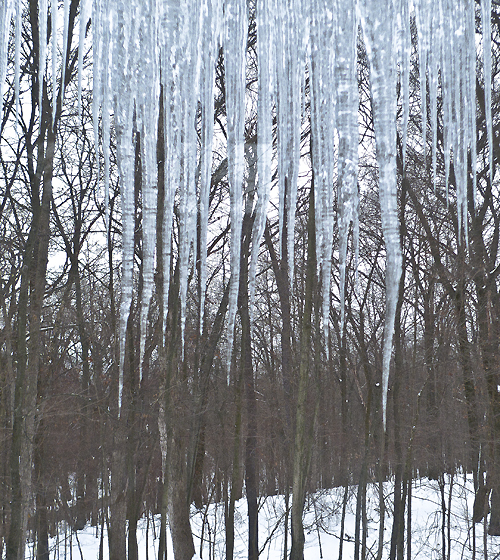
Subjected to the first exercise from Nicolaides ‘The Natural Way to Draw’, I drew the contours of the icicles following Nicolaides instruction:
Focus your eyes on some point – any point will do – along the contour of the model. Place the point of your pencil on the paper. Imagine that your pencil is touching the model instead of the paper. Without taking your eyes of the model, wait until you are convinced that the pencil is touching that point on the model upon which your eyes are fastened. Then move your eye slowly along the contour of the model and move the pencil slowly along the paper. As you do this, keep the conviction that the pencil is actually touching the contour. Be guided more by the sense of touch than by sight. THIS MEANS THAT YOU MUST DRAW WITHOUT LOOKING AT THE PAPER, continuously looking at the model.
First, using plants as my models, I was surprised, during the exercise, at the affection I felt for their leaves. Next, I tried the trees outside the window, and then the icicles suspended from the roof.
Being, so far, more of a photographer than a draftsman, I took a snapshot of this wintry scene.
Posted by Birgit Zipser on June 27th, 2010
Seeing the mist rolling in from the lake over the big dune,

coming closer, enveloping,

until finally, only feeling surrounded by grey.
Posted by Tree Smith on June 21st, 2010
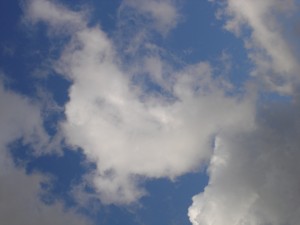
I thought it would be nice to share some photos of the sky on the one day of the year when we have the most time to look at it.
I took a series of photos of the sky over a period of about three months quite some time ago and I hope to return to the subject again one day. I would love to see these printed large and on a wall for people to get lost in.
How many of us look to the sky for a message of some sort? Happy Solstice.


Posted by Birgit Zipser on April 10th, 2010
A natural riverside park were I went to relax – a long time ago.
 more… »
Posted by Steve Durbin on March 16th, 2010
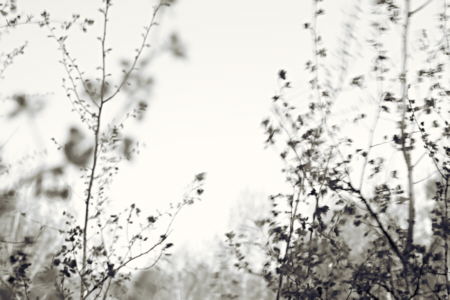
In Praise of Trees is the name of my show with printmaker Kerry Corcoran, which opened about a week ago at the Bozeman Public Library. The Atrium Gallery is essentially the combined entrance halls from two sides of the new (environmentally-certified) building, resulting in a broad, L-shaped space intended for exhibitions. It does get lots of traffic, though much of it under 12 years old. We applied and were accepted over a year ago.
more… »
Posted by Birgit Zipser on January 5th, 2010
Finely ground black sand overlies coarser light sand at a particular location along the shore of Lake Michigan.
Rough surf paints in black sand.
 more… »
Posted by June Underwood on November 12th, 2009
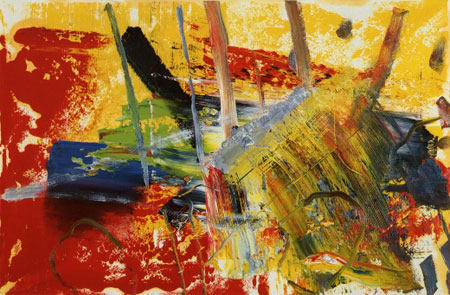
Gerhard Richter, 1985, 57.4 cm x 86.4 cm, Oil on paper
The Henri Art Magazine (written, I think, by several authors) has a fascinating continuation of a discussion of color, “Color: Simulation,” published on Wednesday Nov. 4, 2009.
The author discusses how the perception of color has changed with technology, the technology that presents any color you want: directly out of the can (reducing the need to use traditional techniques to create luminescence or brilliance by direct observation and experience); and then, further “enhancing” and changing color as we know it, technology can produce a pure physics of color through light technologies (as seen on the computer screen.) This, he insists, has produced color as desire, as consumer directed, and loses color as personal and emotive.
I can’t do justice to the writer’s observations; you’ll need to read them yourself. And I’m not sure the polemic need be as strong as it is.
But I was reminded of Steve’s black and white photography, (also here, on A&P) and along with thinking that Steve’s work clearly transcends point-and-shoot photography of the digitized masses, I suddenly understood how the black and white refuses the seduction of the digitized web versions of color.
more… »
