Posted by Birgit Zipser on September 7th, 2007

Keystoning or the distortion of vertical lines was a concern last year when I photographed paintings. On dpreview.com, I learned that to avoid keystoning one should hold the camera on a parallel plane to a painting and then shoot at the longest zoom setting. more… »
Posted by Sunil Gangadharan on September 6th, 2007
I posted sometime back on living the art life and how it would be great to have one’s personality be in tune with art such that the art and person blossom to their fullest… I was thinking about the art life a lot after reading reports on art done by people of questionable backgrounds (some of whose victims are now demanding that the artworks be rescinded and not be considered works of art). more… »
Posted by Bob Martin on September 6th, 2007
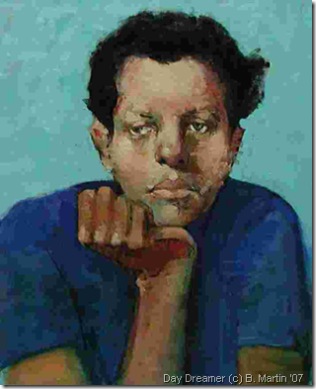 This is the end product of a demo I posted on another site. The process I used was to do a series of acrylic washes until I thought I knew the person I was looking for in this painting. Then started to build in oil, leaving some of the acrylic visible. I kept from moving away from my original idea by avoiding the urge to make everything perfect. I thought about making the hand smaller or detailing the neck line of his T-Shirt, but it remained just a thought. I had the feeling that I was done and it was time to move on to something new.
Posted by Steve Durbin on September 5th, 2007
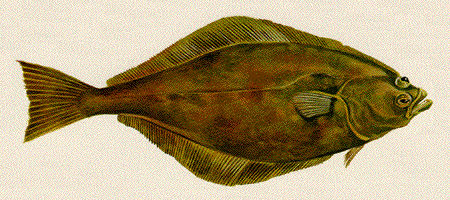
Predictability is fine in its place, but it can be overdone. This post is for the halibut. An open thread for anything that comes to mind. Your comments are all.
Posted by Steve Durbin on September 4th, 2007
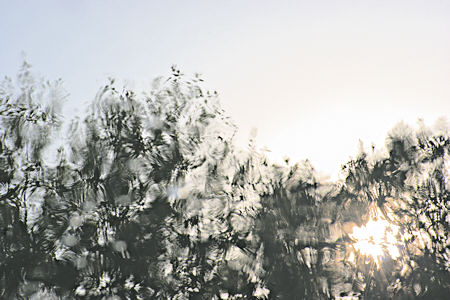
Last week, on my way to somewhere else, I spent a little time wandering in a park and happened on the scene you see above. As you may guess, it is a reflection of trees in a slow-moving stream, which I inverted to present to you as a painterly dreamscape.
A moment later, from the same position, I made the following photograph of the same subject. If the first conjures a dreamy impression, the second may make you rather think nightmare. Why are they so different?
more… »
Posted by Karl Zipser on September 3rd, 2007
Painting From Life vs. From Photos

I first posted this interview a year ago. Dan Bodner has continued with this work. A follow-up interview will appear soon.
To paint from a photograph is inherently different than painting from life. Some artists avoid photos, others use them, perhaps covertly, for practical reasons. But to American artist Dan Bodner, painting from photos is not merely a technique, but a way to focus on his role as an artist. I interviewed Bodner at his studio in Amsterdam.
Question: When you work from photographs, do you ever ask yourself, what is the point of making the painting, when the image already exists in the photo?
Bodner: No. A photo is a record of a moment that has passed, a dead moment. I don’t feel that I own the image as a photograph until I paint it as a painting. The photo itself always refers to the past. But a painting of the photo is a creation, which goes on living. The painting defines its own continuing moment in time.
Question: Does painting go beyond the goal of simply making an image?
Bodner: What painting is for me is part of human desire. Every kid smears his food, or shit, and that is really connected to what painting is. A kid makes a mark and has the satisfaction of knowing “I made this and it will stay there.” For an adult I think it is connected to fear of death, which is innate. And it is connected to the desire to procreate. As you get older it gets existential, of course. To take things out of you and put them into the world, there is an absolute satisfaction in that. To do this from a photo emphasizes the act of creation, bringing life to something dead.
____
In the next post more about how Dan Bodner uses photos, his subjects and his methods
Posted by Jay on September 1st, 2007
An issue that has affected the plastic arts of virtually every culture over time is that of visibility, as art has a persistent tendency to be seen. Many attempts have been made to deal with this without any real measure of success. For example, glass as a medium was heralded as a remedy until it was pointed out that, while one could see through the glass, one could usually see the glass as well.
Other initiatives have been undertaken, including a number of experiments with fabric. The extinguishing of lamps has long been employed, as has the closing of doors and windows. These practices have often been criticized as effectively throwing the baby out with the bathwater, but continue to be widely employed. In the mid twentieth century, however, a paradigm shift resulted in at least one person puncturing a balloon in a museum and then declared the helium thus released to be a work of art. The event in question was greeted with the sound of one duck clapping
more… »

