Posted by Karl Zipser on July 16th, 2007

Painting From Life vs. From Photos
On Saturday I posted about Ultra Minimal Non-Conceptualism, which I claim is to be the Big New Thing. Yesterday a venture-capitalist art collector (let’s call him S.) contacted me. S. wanted to buy the first exemplar of an Ultra Minimal Non-Conceptual artwork.
We started our discussion of the commission with the most important question: what would the first Ultra Minimal Non-Conceptual piece cost? more… »
Posted by Karl Zipser on July 14th, 2007
Painting From Life vs. From Photos
Art without a “conceptual edge” can nowadays seem “out of it”, un-hip, old-fashioned. Art that is little more than the ultra-minimalist depiction of a concept can sell for millions. Why is the conceptual trendy, and how to cash in? more… »
Posted by Birgit Zipser on July 13th, 2007
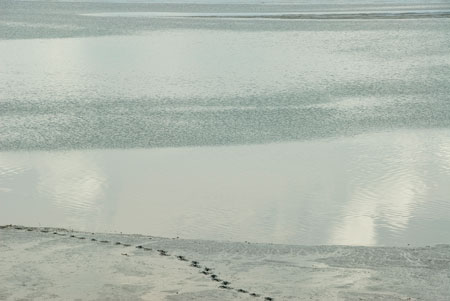
I am visiting the Wattenmeer (mud flats) where I grew up.
more… »
Posted by Sunil Gangadharan on July 12th, 2007
Van Gogh did self portraits because he had no money to pay models. Rembrandt used it as a vehicle to improve his artistic skills as well as to study the minute emotional states inflicted by muscular inflections on his face. Women artists of the 1800’s did it because they were not allowed access to live models and social restrictions made it difficult for them to paint publicly. Others like Frida Kahlo examined the different psychological underpinnings behind the ‘self’ using the self portrait as a tool, a vehicle. Gentileschi used the portrait as a mask that tended to hide the viewer from the self that the artist wanted to conceal. There are so many different reasons for creating a self portrait.
It is also instructive (and fun) to read the opinions of Art and Perception contributors to this art form. more… »
Posted by Steve Durbin on July 10th, 2007
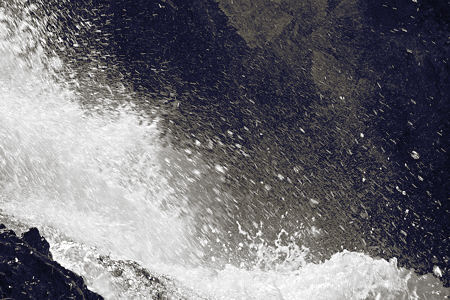
I could be accused of being stuck on my waterfall project lately, but my excuse is that it seems to connect to various other recent posts and comments. Anyway, it’s the work that I’m closest to at the moment, so it makes sense to write about it while it’s fresh. Fresh enough that the ideas are still churning around without order, which in truth is how I like it. I’m inclined by nature to let things ferment in their untidiness, not attempting to resolve or define, hoping/knowing that that will happen on its own eventually.
So this post is partly a record of the connection between concepts and execution, between thinking about the photographs and making them. In the present case, this is a pretty loose and interactive connection, perhaps similar to David’s “chickens, then eggs, then more chickens…” or Leslie’s “dialogue with the idea going back and forth with the making in a pretty comfortable way.” Karl also has been considering the role of concept in art, and I think his question, “Is art something we make, or discover?” is about the same thing. In other words, do we create from a concept or learn by doing? The answer, of course, is that both go on at once, but how it plays out is always different, even for me alone on this single project.
more… »
Posted by Birgit Zipser on July 9th, 2007
Posted by Karl Zipser on July 7th, 2007
Painting From Life vs. From Photos
Conceptual art represents concepts.
That seems obvious.
The simple statement has some interesting implications, however. Let’s explore by looking first at another art-form: still life.
What does still life art represent? The still life, obviously. Each still life painting shows a given set of objects. Is the still life art the same as the still life itself? Of course not. It’s a representation: the appearance of a still life on a canvas is an illusion.
Does the artist create the objects in the still life? Perhaps he or she might throw the vases and cut the flowers, but this is not essential.
Must the objects be valuable or beautiful? Of course not. The value of the still life art depends on the quality of the representation, not on the quality of the things represented.
Now, back to conceptual art. more… »