Posted by June Underwood on July 6th, 2007
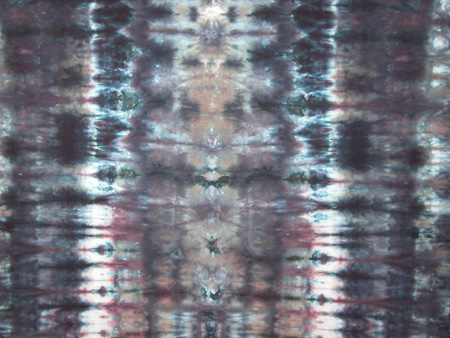
In an interview for a quilting magazine recently, I was asked why I liked oil paints. I found myself speaking lovingly about the names of paints — burnt sienna, cadmium yellow, quinacridone magenta, perylene black, French ultramarine.
My response surprised (even) me. I hadn’t actually thought of the names of colors as a reason to like a specific medium. Thinking it over, however, I came to understand why I fell into praising the precisely designated oil paints. And watercolor paints. And even acrylics.
It isn’t the names, charming as I find them, so much as it is that the names signify a specific color that holds fairly true across media and brands.
To understand the hold that standardized pigments have for me, you have to know that I began my color education with textile dyes rather than pigment paints. Once you have struggled with making art with dyes, you find that using pigmented paints seems ridiculously easy.
Here are reasons why dyes are inherently difficult to control.
more… »
Posted by Sunil Gangadharan on July 5th, 2007
Under the catchwords of accessibility and inclusiveness, a lot of artifacts in the art world are losing its original meaning and interpretations thereof. Simply put: We inhabit a culture of simplification and generalization with the hopes that unpretentious agendas would be understood and assimilated by a larger audience. This has been documented extensively in other fields and is now seen to be creeping into the arts as well. Two examples from either sides of the Atlantic would further illustrate my point. more… »
Posted by Steve Durbin on July 3rd, 2007

As regular readers may know, I’ve been intrigued by resemblances noted between some of my photographs, particularly the recent waterfall series, and those of Clyfford Still, the eccentric Abstract Expressionist determined to go his own way, living most of his life in relative isolation from the art world. Over the last year or so, I have sensed some movement toward abstraction in my work and I would like to explore that. What is abstraction for me? How does it relate to representation? What and how does it mean? I’m not aiming for a more sophisticated Statement, I’m just trying to better understand what I do and what others have done and what I can learn from it.
more… »
Posted by Karl Zipser on July 2nd, 2007

Painting From Life vs. From Photos
In my previous post I discussed conceptual- versus procedural-based art and asked how an artist could have the two dimensions interact. This got me thinking about how different art forms mix these aspects. Contemporary conceptual art, for example, tends to be big on ideas and light on craft, whereas something like the Painting a Day movement is more procedure-based. Renaissance art, in contrast, combined conceptual and procedural components.
Below I try to express this distinction in a two-dimensional plot where the axes are Conceptual and Procedural.
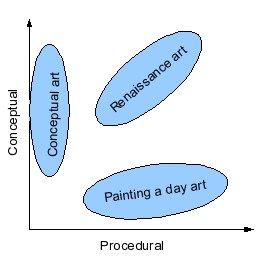
Note, nothing about this hypothetical representation says anything about the quality of the artwork. It is possible to have a technically developed artwork, full of ideas, that is just plain bad. Conversely, a simple, non-conceptual painting could be something wonderful.
Where on this graph would you like your work to be? Where do you think you are now?
Where is the money today? It seems that the conceptual gets rewarded more than the procedural.
Posted by Karl Zipser on June 30th, 2007
Painting From Life vs. From Photos
Jeffrey Augustine Songco recently posted about different modes of art making. [UPDATE, Jeffrey kindly pointed out (comment 3) that some of the points I make about his work are oversimplifications]
He divides his art into two types, which I’ll call x and y. I use these neutral names because the names that Jeffrey used, although descriptive, are somewhat distracting for the point I want to make here.
Art type x “is thoroughly planned (at least as much as I can) and must specificaly state the meaning that I am ultimately trying to convey,” Jeffrey says. He almost never displays art type x in his studio on a normal day. It is what someone else would hang up and call art, but he prefers to look at type y.
With art type y, Jeffrey says “I find myself getting lost in during its creation. It is something that has no specific goal other than to explore my mind creativity.” This type of art is what Jeffrey would (and does) display for himself, and calls art.
Thus, art type x is “concept first” art. It is focused on an idea of what an artwork could be. Art type y is “process first” art. In terms of tangible product, the type y art seems to yield better results — as Jeffrey says, this is what he likes to look at.
Reading about art types x and y in the original post, I wondered, why make art type x at all? Why not simply do type y? I asked Jeffrey this and he replied: more… »
Posted by Birgit Zipser on June 29th, 2007
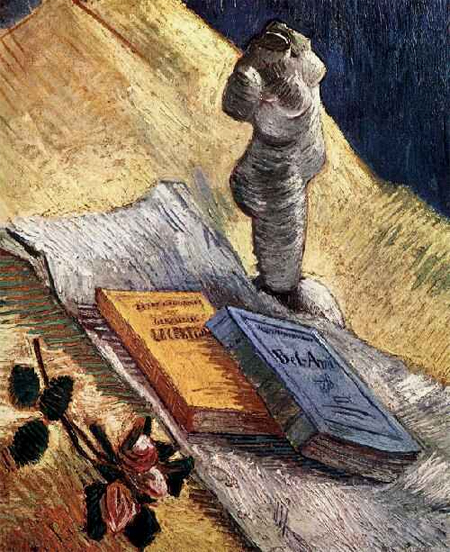
Looking for imaginative interpretations of perspective by Vincent van Gogh, I came across his Still Life with Plaster Statuette, a Rose and Two Novels. It reminded of someone else’s still life posted earlier on A&P that was critiqued for grapes that seemed to be sliding of an underlying cloth.
more… »
Posted by Sunil Gangadharan on June 27th, 2007
What led to this post was a quick read of Jay’s comment the other day on the differing perceptions between an actual painting and the computer screen version of the image. A revelation occurred when I had a showing of my paintings at an arts fair recently: A lot of people responded very positively to the works upon physically looking at the works (these were the same people who had already seen it on the computer screens before and had not thought too much about it). They said that their feelings towards the subject/painting changed when they looked at the painting life-size. more… »