Posted by Arthur Whitman on June 26th, 2007
My taste in art—especially painting and drawing, but also other mediums—tends towards the strange, the mutant, the science fictionesque. This isn’t because I hate nature, but rather because I feel that art should offer something else, a surrogate (as Jackson Pollock once famously said to Hans Hoffman, “I am nature”). This kind of stuff probably isn’t to everybody’s taste, but what the hell.
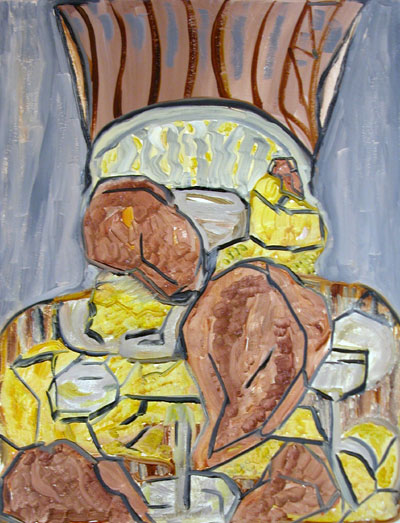
I’ve been interested in Nava Lubelski’s paintings for something like three years. They seemed a bit lightweight when I first discovered them at Boston’s OHT Gallery. They’ve grown on me since then and I think the pieces themselves have gotten less uneven. Her method is unusual. She stains and splatters her canvases with thin washes of ink and acrylic paint in different colors. She then hand-stitches thread (again in various colors), tracing the outlines of the stains and creating new patterns as well. Some her recent canvases even have holes in them; A Lie About Birds and Bees is an impressive example. The results are reminiscent of abstract expressionism, as well as the post ab-ex tradition of color field painting. They also evoke birds-eye views of landscape or snorkeling—favorite themes of mine. At their best, the canvases are fascinating, intricate things.
In her artist’s statement, Lubelski describes her process in terms foreign to those of the stereotypically masculine world of abstract expressionism. She describes her staining as “spoiling” and her stitching as “mending”. The pieces are meant to suggest a duality of accident or wildness versus care and precision. I’m not a woman, but I do find this approach congenial.
Lubelski is also the author of a book: The Starving Artist’s Way. I haven’t read it, but it appears to be a sort of bohemian do-it-yourself guide. Her website also features several drawings and mixed-media sculptures (my favorite).
Posted by Steve Durbin on June 26th, 2007
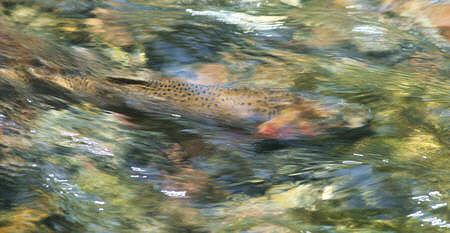
Are artists who ignore potential political impact of their work irresponsible? If the work is subject to misinterpretation or misuse (and what isn’t?), is it the job of the artist to consider this in advance? Is self-censorship in the service of your own beliefs necessary?
more… »
Posted by Karl Zipser on June 25th, 2007
Painting From Life vs. From Photos
Mind you, the most perfect steersman that you can have, and the best helm, lie in the triumphal gateway of copying from nature. And this outdoes all other models; and always rely on this with a stout heart, especially as you begin to gain some judgment in draftsmanship. Do not fail, as you go on, to draw something every day, for no matter how little it is it will be well worth while, and will do you a world of good.
—Cennino Cennini, 14th century
Cennino’s statement that studying from nature is the best way to learn to draw is something that resonates today. My question is, what constitutes “copying from nature”? Is drawing from photographs the same as drawing from life? Or is working from photos more like copying the work of another artist? The question is of practical importance, because as Cennino pointed out, studying the work of another artist will influence one’s personal style.
We cannot separate how we see from the way photography has informed our vision.
—Dan Bodner
. . . it is best to remember that every object made by man carries within it the evidence of the time and place of its manufacture.
–Joseph Veach Nobel
If an artist draws from photos, does he or she inevitably absorb the unique “style” of the camera (not to mention the style of the photographer)?
Posted by June Underwood on June 22nd, 2007
It’s interesting to see Sunil lamenting the lack of contemporary portrait artists as I consider my own dilemma — too many landscape artists. Or maybe just too many that follow me into drugstores and gift shops.
How do you respond to the old masters, those artists whose work stuns you and also follows you, ubiquitous, featured on postcards, tea pots, and backsides everywhere you go? This is a question I’ve been pondering.
Recently on the blog I adminster, the Ragged Cloth Cafe, one of the regulars posted a blog on Ansel Adams. My response to her comments was a bit jaded, or maybe even irritated. Another of the regular posters on the blog called me on it: “June, you do sound a bit cranky and a bit unfair to modern landscape photographers. Or is it like seeing drip painting and only being able to think of Pollack?”
As I reread what I had written I realized that indeed I was sounding more than bit cranky (and even a bit incoherent). After a few further comments I sorted out what my head was thumping around with, dissing Adams. Here’s something of what I wrote:
You may have hit on why I am currently in a state of irk-dom about Adams — it’s because I’m trying to find my own way with landscape and his images loom altogether too large in my mind. I have to wrangle and fight with him a bit (Jacob and the angel?) to make my way to my own vision.
I often find this is the case for me — at various times in doing my art, I find myself fighting my way through to my own style, arguing (if only with myself) about the too-much-with-us-giants who block my view.
I think this is yet another version of Karl’s posts here and here) “Why is making art so hard?” I had the same difficulty with the Cubists (see the two homemade oils that flank this post) with whom I spent the last 10 days harrassing and wrestling. Oddly enough, though, I don’t have the same issues with Cezanne. It may be that he is just far enough out of the old masters/coffee-cup loop to give me fresh insights rather than making me strain and struggle to see afresh.
It’s not that I blame the artists for being so outstandingly good (even I admit that that’s a bit over the top); it’s that to see afresh is such a struggle that I want to fling a paint-loaded brush onto my memory book of Adams’ photos and smear them thoroughly so I’m not seeing them while I’m working. It’s a kind of internal thrashing about, trying to break through to the other side.
more… »
Posted by Sunil Gangadharan on June 21st, 2007
As I have indicated here before, I revel in painting faces of our fellow human beings. I am not too sure when it first hit me that painting a face might be a good use of my ‘art’ time, but having hit upon it I find that I am enjoying myself immensely. more… »
Posted by Leslie Holt on June 20th, 2007
The “tradition” of using non-traditional materials and found materials in art goes back awhile – from Braques and Picasso’s collages to Duchamp’s urinal. By now we are accustomed to seeing everyday things in the museums or galleries For me, the use of non traditional or found materials has to transform that material so that it becomes something else than the novelty of the material itself. A couple of artists came to mind when thinking about this today. I recently discovered and artist named Il Lee.
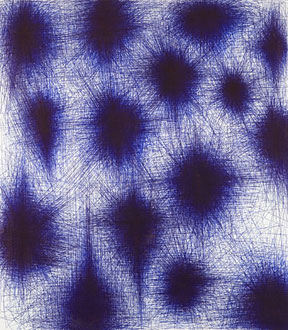
BL-069, 2006, Ballpoint pen on canvas, 48 x 42 inches more… »
Posted by Steve Durbin on June 20th, 2007
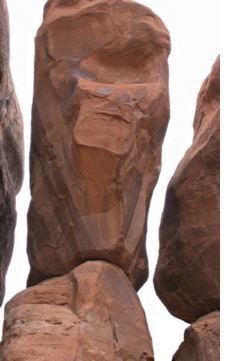 When I first showed these rock formations I’m calling Bones of the Earth, I was quite unsure what to do with them (I still am…). They seemed to invite a number of treatments. In particular, I found myself wishing I could paint them. Since I’d been admiring Sunil’s paintings of late, I naturally wondered how he might handle them: “Sunil, are you out there? Imagine these rocks as a weathered old face, what would you do with it?” I was not thinking that Sunil would actually see a face in them, but rather that considering the rock surface as skin might suggest coloring and brushwork that would give an interesting treatment. That was before my own musings on the power of face recognition. And if anyone has an over-developed fusiform gyrus in his brain, it’s Sunil (I can barely rotate 90 degrees, he easily does 180). Well, as you can guess, Sunil did see a face there — in fact three — and has recently posted on his blog the painting that resulted. It’s reproduced (with permission) below:
more… »