
Archives for 2007
Art & Imagination

Painting From Life vs. From Photos
Cennino Cennini devotes his Il Libro dell’ Arte (late 14th c.) to a practical explanation of the materials and techniques of painting. And yet Cennino also writes of painting as an occupation that deserves “to be crowned with poetry”, because the painter has the ability to compose from the imagination, “presenting to plain sight what does not actually exist.”
 It might seem there is a mismatch between focusing on the physical aspects of the work, and at the same time emphasizing the role of imagination in creating art. But this combination of the mundane and the fanciful is appropriate for a simple reason: an artist creating from the world of the mind must nonetheless work in the world of the materials. The physical nature of those materials, and the way the artist uses them, will inevitably influence how the inner world of the mind is discovered and expressed.
Contemporary artist Hanneke van den Bergh recognizes and makes use of this interplay of the imaginary and the physical in her clay sculpture. She explains “I like to make the heads by moving a little lump of clay until I can just see the face. I like this quality of the imaginary form beginning to emerge from the raw material.” Van den Bergh does not attempt to disguise the properties of her materials. In the example shown here, Danae III, she leaves visible the coils with which she constructs the main form. The contrast of the repeating pattern of coils with the rhythm of the body contributes to the expressive effect of the work. “By avoiding too much detail,” she says, “I maintain the contrast between material — the physical — and the imaginary.”
Manhattan Men In Motion

Some weeks ago there was a discussion on this blog about why I don’t photograph people as part of my studies of Manhattan. Since that discussion, I have, of course, become obsessed with photographing people. In case you were looking for an example of how we influence each other on this blog, you now have a very good example.
With all respect for the various and wonderful women of the world, as a man there is an undeniable connection between my brain, my eye and my penis so, not surprisingly as a gay man I have pretty much focused my camera on me…and the streets of Manhattan are chock a block full of beautiful and sexy men. And at the risk of stereotyping and generalizing, as walkers, men and women are very different. Men are going somewhere and they are focused on that–even if it’s nowhere–almost oblivious to there surroundings. Women are observers. They’re moving more slowly and looking at store windows, how other women are dressed, what possible threats there may be to their safety–and if they’re being led by a man, they are never looking forward. It’s actually pretty funny to observe.

I’ve also learned that male Manhattanites are so focused on their “missions” that you can stick a camera up a man’s ass and he’s likely not to notice unless it has a vibration mode–and even then he might mistake it for a passing subway train. As a result I’m loving the ability to capture unposed body language and, more specifically, Manhattan male motion.

How to find a style? –Cennino’s take
Sometime in the 14th century, Cennino Cennini wrote Il Libro dell’Arte as advice for how to be an artist. One of the most interesting passages, I think, is how an artist should go about developing a personal style. Cennini begins:
take pains and pleasure in constantly copying the best things which you can find done by the hand of great masters. And if you are in a place where many good masters have been, so much the better for you.
The point of the exercise is to learn from the source. This means that the choice of master to copy is important. Cennini continues:
But I give you this advice: take care to select the best one every time, and the one who has the greatest reputation. And, as you go on from day to day, it will be against nature if you do not get some grasp of his style and of his spirit.
Selecting the right masters to copy is still not enough. Cennini recognized that the particular interpretations of one artist needed to be studied consistently:
For if you undertake to copy after one master today and after another one tomorrow, you will not acquire the style of one or the other, and you will inevitably, through enthusiasm, become capricious, because each style will be distracting your mind. You will try to work in this man’s way today, and in the other’s tomorrow, and so you will not get either of them right.
By choosing the right artist to study, and by studying his work consistently before studying that of another artist, one will achieve the preconditions for finding a personal style:
If you follow the course of one man through constant practice, your intelligence would have to be crude indeed for you not to get some nourishment from it. Then you will find, if nature has granted your any imagination at all, that you will eventually acquire a style individual to yourself, and it cannot help being good; because your hand and your mind, being always accustomed to gather flowers, would ill know how to pluck thorns.
Serious vs. Decorative: a Ladder’s Story (by Jay Hoffman)
I have thought about ladders, and over the last four or five years I have made some.
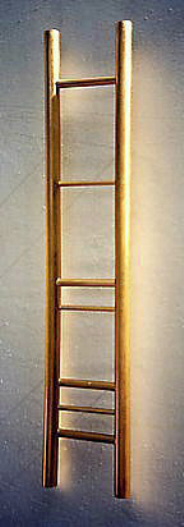
The whole thing may have arisen from cleaning the gutters or some other patchwork chore related to holding the house together. What emerged from my ascents and descents, bruises and strains was an awareness of the ladder as a sculptural framework that regulates motion, and to some extent, emotion. I might have felt aspiration as I toed tentatively yet deliberately upward, toward the peeling patch of paint under the eaves. I might then have felt exasperation as I discovered that I hadn’t brought the scraper with me and now had to gingerly make my way back to the ground.
There’s nothing like having one’s nose up against a rung to encourage contemplation, especially when it’s going to be there for a while. I pondered ladder-ness as a sculptural premise. Big, little, red, green, yellow? How much detail? Would a ladder sculpture be enhanced by the inclusion of cleats, rods and other such? Was there an acceptable level of abstraction? What would be the point?
Dunes and Lake
Walking up through lush forest
Is Craft Art?
Recently, I had a good showing at an arts and crafts festival near my house and I blogged a bit about the show here. What caught my interest peripherally during the show and more as I think about it now was the prevalence of crafts into shows like these and the dilution of the power inherent in the crafts by the artisans that create these crafts by purposely subverting their wares to dress them up like art. Let me explain. Close to my assigned booth, I met this charming lady (she is actually trained as a silversmith) who made jewelry. Her booth was crammed with styrofoam busts of women wearing custom designed jewelry and the whole setup looked really nice and beautiful from far. During short breaks from the steady stream of visitors, I would go by her booth and marvel at the designs that she created in silver and grimace at some designs that she created out of glass/silver. The silver creations were exquisite, the design fetching and the pieces very compelling to look at and buy (in fact I even asked my wife to look at a piece but she later chided me on the price). The jewelry made of painted glass beads on silver strands with the glass over painted with strange designs seemed lower in quality compared to her silver works. On asking her the price of the painted bead based jewelry, she explained that she was slowly branching out into ‘art’ and the prices for these were almost double the prices compared to equivalent silver pieces. I remember walking out of the booth with a strange feeling in my head.
Firstly, the painted glass pieces with a bit of silver strands were not good as the hand made silver pieces (from a purely aesthetic perspective) but they commanded extra prices because they were considered ‘art’.
Secondly, it looked like glass was being used for a purpose for which it is not inherently suitable – glass is great when blown or stained, but when it is hand painted and added along with other beads to make tacky jewelry, it loses the freshness inherent to glass and it makes for bad craft.
It almost seemed like the market forces that congregate around ‘art’ is pushing people to create work that is substandard and at the same time giving them less time to be more creative at what they are trained and good at… At the end of the day, I also understood that she sold much more silver pieces than the ‘art’ pieces.
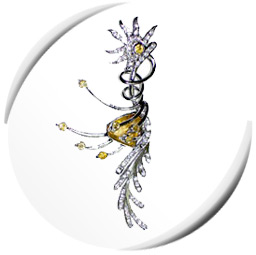 Sterling silver jewelry
 Necklace of glass beads
I was wondering why does she want to dress up her exquisite works under the word ‘art’ when her ‘craft’ can speak for itself (and very eloquently)? Why are craftspeople not proud to say that their work is ‘craft’ and keep trying to pay obeisance to art and try selling their works labeled as art? Is there a perception that when works are referred to as ‘art’, they are automatically elevated to another plane all by itself? Shouldn’t craft be on an equal plane? Is the word ‘art’ and by extension ‘artist’ over-hyped?
