Posted by Steve Durbin on June 13th, 2007
I was struck by something David Palmer said (comment 7) on my recent post on waterfalls:
…there’s something about the waterfalls that really captures for me the change in energy we experience in winter. The actual slowing of molecules. It’s as though by seeing this microcosm we experience something much larger.
Very poetic and all, but beyond that? In any case, it inspired me to think about the water molecules that you could see if you zoomed in with a super-microscope. So I did just that — digitally. The images in the following sequence are waterfall #2 (chosen for its square format) and successive two-fold magnifications of the center of the preceding image (but the actual image display size is reduced by less than that, so they don’t get too small):
more… »
Posted by Steve Durbin on June 12th, 2007
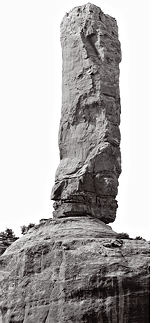 Sure the title is a pun I couldn’t resist, but it’s also the lead-in to a serious question about art and perception. It arose in the context of a photography trip to Utah last April, which began in Arches National Park. A few weeks ago, in Bones of the Earth, I made my first post about the project with that tentative title, which comes from the impression that the exposed rocks represent structures normally below the skin of the Earth.
The rock formations in Arches and elsewhere are of many shapes. Among them are ones that can’t help but bring the word phallic to mind. The first picture I took that first morning (first image below) already fit into that category. That’s not why I made the photograph — at least not consciously — but it’s something that occurred to me at roughly the same moment I decided to set up the camera. And although the rock can certainly stand on its own as subject, it’s possible that the subliminal association helped draw my attention to it.
more… »
Posted by Karl Zipser on June 11th, 2007
Painting From Life vs. From Photos

I always enjoy painting skies. Part of the reason, I think, is that I never know the result ahead of time. The process of painting the skies is not entirely random, of course, but within the system of constraints I use, there is a large element of chance as to how they will develop. A slight unevenness in the over-painting blue becomes the seed of a cloud. The negative space of one cloud becomes the seed of another cloud. And so forth . . .
There is a big difference from photography here in the unfolding interaction with chance. A lucky photograph is made in milliseconds. Perhaps the result will inspire more photographs to capture the moment; but each photograph achieves its essential identity with the press of a button. Painting the skies is something more like an ongoing improvisation, technical context providing a stable base rhythm. The effects of chance are something I can explore over hours and days in the context of a single image.
Sunil’s post about luck in photography got me thinking about the role of chance in art. I wonder, is there an element of art that does not develop from some chance event? I’m on the verge of saying, art is about the harnessing of chance — except that is an oversimplification, and also I remember hearing it somewhere else before.
And yet, what is the alternative to the random? Religion informs us of the notion of Free Will. Science reminds us that there is only the random and the deterministic. Which makes better art?
Posted by Steve Durbin on June 8th, 2007
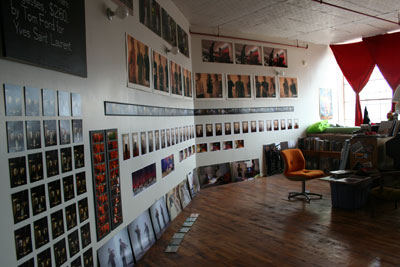
This past weekend, I opened the doors of my live/work studio as part of the Bushwick Open Studios and Arts Festival in Brooklyn, New York. It was my first open studio, so I had the opportunity to plaster the walls with my art that had been collecting dust under my bed. The art I hung was the kind of artwork that I considered to be my contribution to the history of art—the work that I would want to be a part of the ‘art world’ and more specifically, artwork that I would submit to galleries for open calls. Here is an example of my open studio space:
more… »
Posted by June Underwood on June 8th, 2007
In a small art group that Jer and I belong to, we were given a challenge: for the next meeting, we were each to create some form of art based on “biscuits.” That meeting will be next week. I have to make some art. Using “biscuits” I came up with an anagram: “is Cubist.” I will make a Cubist-style painting, containing biscuits.
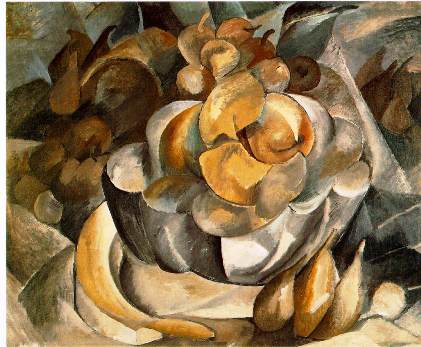
I thought the exercise would be simple. I would look at some Cubist works, get a couple books from the library and raid my bookshelves to see what others had to say, decide on motifs beyond the biscuits, and do a few sketches. Then, I would be ready to paint. more… »
Posted by Sunil Gangadharan on June 7th, 2007
The one thing that has always struck me about photography is the fact that a good picture combines both the skill of the photographer and some amount of luck that the photographer has no control over.
The picture below will illustrate my point – in the first picture (taken seconds apart in the vicinity of the destroyed World Trade Center on Sept 27th), the woman is the strong one, the man grieves – in the second the man is strong – the woman grieves. The photographer did not do much other than just chance on these people watching a tragic event. (the artist was there at the right place at the right time – again luck – and got the right pictures).
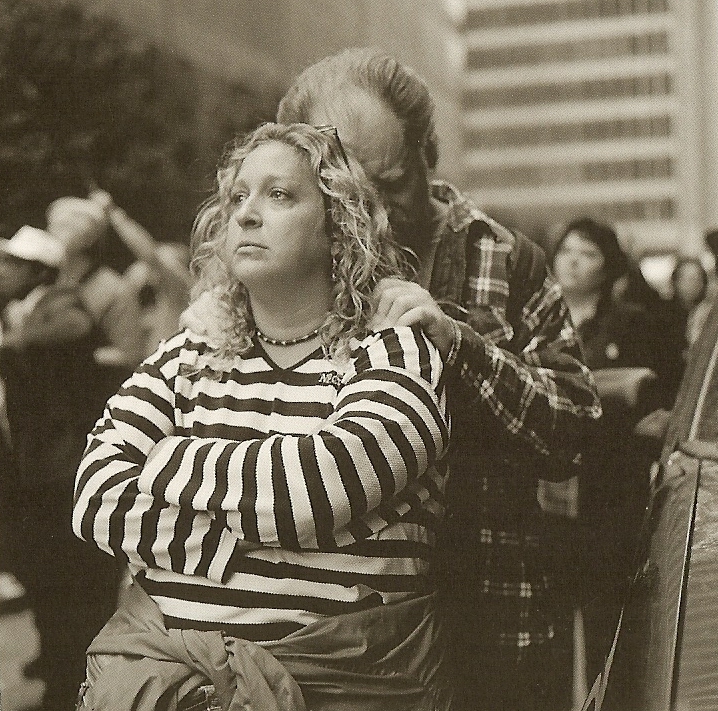
Photo courtesy: Kevin Bubriski
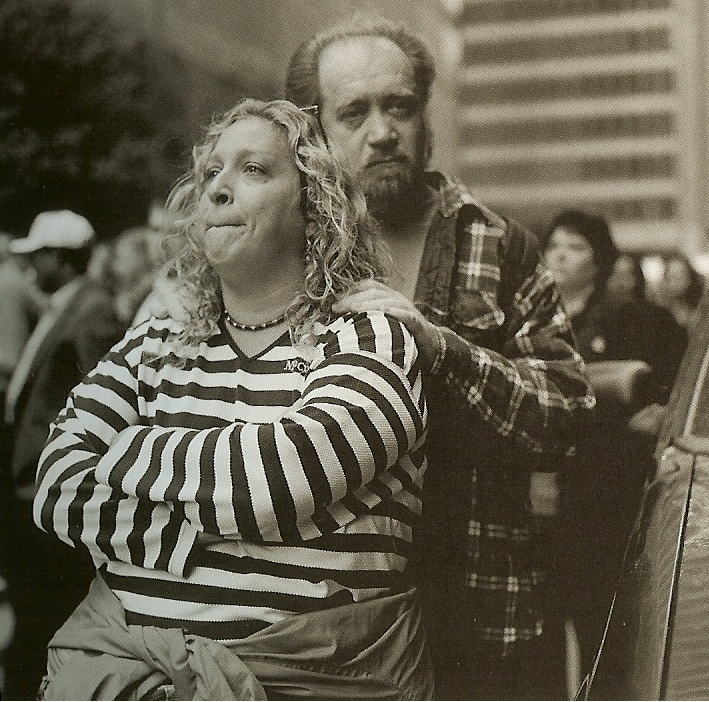
Don’t get me wrong, I love photographs – I look at photography books for hours on end savoring these moments frozen in time by the power of film. Among others, I love Steve Durbin’s work – but behind it all I have a feeling that great photographs is a combination of the skill of the artist and some element of luck. In some ways, I consider abstract expressionist painters the same way – as long as they get some of the accidental splotches of color to line up right and give the picture a unified whole feeling, it looks good; and luck owes a part to getting that accidental splotch of color in the right place on the canvas as was the skill of the painter…
What are your thoughts?
Posted by Karl Zipser on June 6th, 2007
Painting From Life vs. From Photos
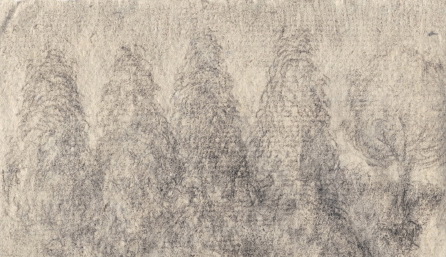
Traveling makes one aware of constraints of time and space. If I am in Paris today, but I won’t be tomorrow, I need to make the most of the present opportunities.
Painting in the same studio from day to day gives the impression of being in the same place. Working with the same types of materials over time gives a sense of continuity. I’m realizing how much this is an illusion, in the dimension of the art itself.
I can look at older work and enjoy it, but I can’t go back to the “place” I was when I made it — as much as I would like to sometimes. Depending on the type of work and the progress I am making, “old” can mean a year or two weeks. What I am doing on a given day defines a “place” that I found a path to from yesterday. I won’t be able to return most likely. I need to make the most of the place where I am at the moment, then move on.
On this journey an itinerary is not available. If I try to look back or too far ahead, I risk losing my way.