Posted by Sunil Gangadharan on May 16th, 2007
I visited a couple of galleries in Chelsea during lunch and one of the galleries that I stopped by was the Merge Gallery where Jordan Eagles is exhibiting his ‘paintings’.
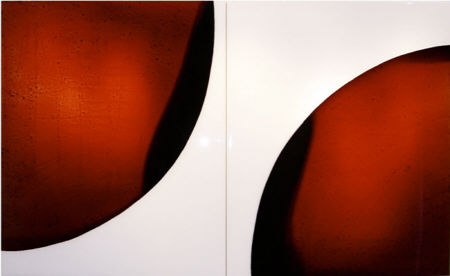
PHASE 1-2; 72″x44″; blood preserved on white Plexiglas, resin
As far as process goes, he uses cow blood trapped between sheets of UV resistant epoxy resin, lets the light play through the myriad textures formed out of the alternating layers of crusted blood of varied thickness and the result is pretty good. When you look at the work closely in person the alternating layers of deep red definitely lends the pieces a strange surreal beauty and looks mesmerizing – turn the lights down and the works start to glow refracting any available light through the layered epoxy resin. I enjoyed it in a surreal sense…
more… »
Posted by Steve Durbin on May 16th, 2007
I can’t remember how I heard of it, but I recently picked up a book by the British artist and writer David Batchelor called Chromophobia, published in 2000. Batchelor’s thesis is that color is “the object of extreme prejudice in Western culture” and that this has gone unnoticed. I was curious about this because, though I have had my flings with color, I choose to present my photographs mainly in black and white.
Here’s more:
Chromophobia manifests itself in the many and varied attempts to purge colour from culture, to devalue colour, to diminish its significance, to deny its complexity. More specifically: this purging of colour is usually accomplished in one of two ways. In the first, colour is made out to be the property of some “foreign” body — usually the feminine, the oriental, the primitive, the infantile, the vulgar, the queer or the pathological. In the second, colour is relegated to the realm of the superficial, the supplementary, the inessential or the cosmetic. In one, colour is regarded as alien and therefore dangerous; in the other, it is perceived merely as a secondary quality of experience, and thus unworthy of serious consideration.
more… »
Posted by Steve Durbin on May 15th, 2007
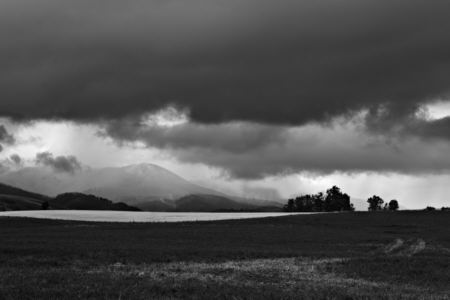
It’s that hair-pulling but hopefully insightful time when I have to write an Artist’s Statement. I’ve done this before for particular projects or shows, but this is the first time I’ve tried to write a general statement about myself as an artist. The purpose is to provide information to interested visitors at the gallery I’ve recently joined. So my audience is the general public, or at least that part which would visit an art gallery. I feel that’s quite a different audience from other artists (like you all), in turn different from a narrower group, such as photographers working in black and white.
I take the statement very seriously as a way not only to communicate, but for me to consider what is really important, perhaps defining, about my artistic endeavor. The tone of it is critical. I don’t want to be too “artsy” or intellectual, nor do I want to condescend. I want it to be straightforward, but at the same time I want it to entice and suggest rather than answer all questions. It needs to have a personal voice, to sound like something I would say, and ideally not like something anyone else would say. This is what I’ve got so far:
more… »
Posted by Rex Crockett on May 15th, 2007
Well. It seems we have had a few quiet days here on A&P, so I thought I’d fill in the silence with a little thunder.
If you could see my face, you’d smile.
First, please enjoy this image of Rembrandt’s portrait of Jan Six. At this level of greatness, one must say, as did mmm, DeKooning? Stella? “He is on one mountain; I am on another.”
So I will not say “The greatest portrait in history,” but certainly an Everest. Sorry about the bad scan. It seems that all the better images on the net had that same irritating line about two-thirds of the way from the left.
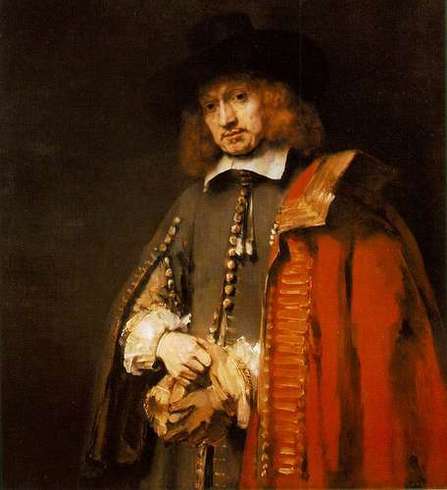
Rembrandt van Rijn, Jan Six, 1654, Oil on canvas, 112 x 102 cm, Six Collection, Amsterdam
A recent comment asked whether any artist today could paint like Rembrandt, Titian, or Raphael.
My answer was that there were many.
But I’d like to add to that. There are not as many as there could be, or should be.
I did not say that I could paint like any of those guys, but I almost did.
Because I can.
more… »
Posted by Rex Crockett on May 11th, 2007
Steve Durbin brought up the question of how do artists cook a while back, but I was not able to comment as much as I would have liked then; furthermore, I came across, again, some famous old thoughts on the subject, and I thought I’d share them with you.
First though, I’ve just been promoted from Sous Chef to Executive Chef at the resort where I work. Unfortunately, I’m always working now at least twelve hours a day. It’s my own fault, the long hours, for I fired all the lazy hacks on my first day on the job. I will have only focused professionalism in my crew even if it means pulling shifts for a time.
Involved as I am with the menu planning and presentation of our banquets for the coming season, the relationship between a practical, applied art, like cooking, and a more ethereal art, like painting, has been much on my mind. It’s been only on my mind and not expressed in art work because of my long hours.
I would not regard the following observations to be completely definitive statements for all art, merely facets of a diamond, and one possible diamond at that. I offer no images in this post, only ideas. But they are some good ones, I think.
more… »
Posted by June Underwood on May 11th, 2007
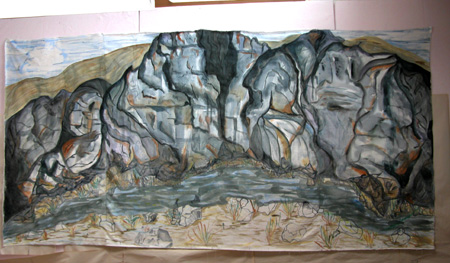
Goose Rock Panorama, 2007, Cotton and watercolor, in progress
I’ve been thinking about the planes on which we work, that is, the stretched canvas, the photograph, and the quilted textile. This is partly in response to my interest in analyzing quilted textiles vis-a-vis more traditional media, say, oil paintings. But my thinking has also been triggered by some reading I’m doing; I’ll reference the readings at the end of this post.
With stretched canvas, some questions revolve around how the picture plane is used (as a window, as a flat surface, or extended out into frontal space and rounded so there’s a back side to the image.) more… »
Posted by Sunil Gangadharan on May 10th, 2007
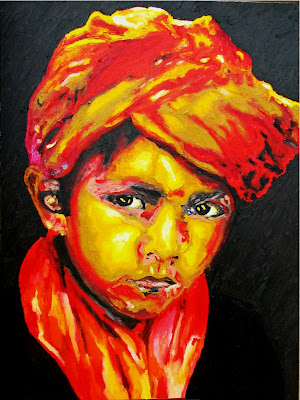
I love painting faces. I painted these over the last three weeks. This time both depict people from India. The first is that of a child pilgrim presumably attending the Kumbh Mela – originally photographed by Steve McCurry. The second one depicts a daily wage earner whose sustenance is ruled by the number of loads carried on the person’s head. They are commonly seen toiling on construction sites.
“Pilgrim“; 3ft X 4 ft; Oil on canvas
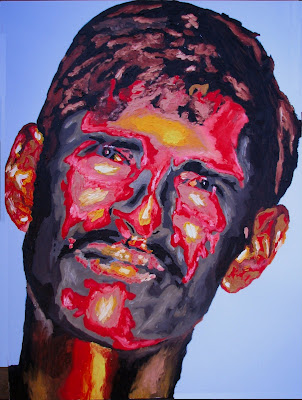
“Coolie“; 3ft X 4 ft; Oil on canvas