Posted by Angela Ferreira on March 20th, 2007

Title: Scrying
Medium: Pencil & Oil on canvas
Size: 140 x 78 cm
This painting was made with a technique I have discovered by reading posts from both Karl Zipser’s and Hanneke’s methods.
I have drawn directly from a combination of life and imagination on to the canvas, shading to some extent and completing it mostly.
When the drawing was absolutely right, then I covered the picture with thin layers of oil mixed with diluents to show some of the transparencies.
I finally overworked to the top leaving some parts of the pencil showing through and some other parts built up with colour and tone.

Posted by Steve Durbin on March 20th, 2007
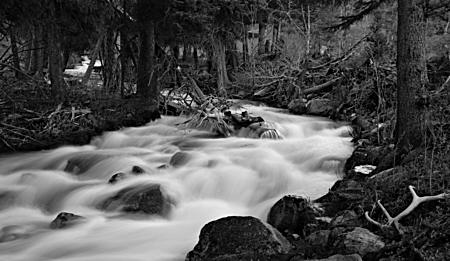
I’m still reading Pessoa, especially his Alberto Caeiro persona, my favorite, who has a seemingly clear and simple view of the world and our experience of it. According to Wikipedia: “Central to his world-view is the idea that in the world around us, all is surface: things are precisely what they seem, there is no hidden meaning anywhere.” Suppose we accept this for encounters with the natural world; how can or should we apply it to looking at art? Can a river, a tree, a rock in an artwork be as innocent of meaning as in nature?
In the spirit of June Underwood’s idea of gathering of A&P contributor artworks to let them “chat” with each other, I’ve gathered a few here to let them also converse with Caeiro/Pessoa. I’ll start with poem 39 from “The Keeper of Sheep,” translated this time by Peter Rickard (original on this page).
more… »
Posted by Doug Plummer on March 20th, 2007

Photographing the Big Sur coast can be daunting. There’s the pesky issue of it being so spectacular. Every turnout looks like a Sierra Club calendar photo. How do I make make something of my own from these environs? What I found out was, to not try very hard at any of it. I found that a sort of creative indirection was the best way to handle the gorgeous scenery.
It is not my first trip to the region. About a decade ago, I got myself a 4×5 camera. The intent was to do a “beginner’s mind” thing with my photography, start over with an unfamiliar technology and see what kind of pictures I would make if I had to compose them upside down and under a dark cloth. I was very intent on what I was doing. I had a plan and a purpose. In the end, I made the expected sort of photographs you get when you trundle around the central California coast with a 4×5. After about three years I figured out that large format was not advancing my photography anywhere I wanted it to go, and I went back to smaller formats.
Another trip I did with stock photography in mind. Those spectacular pullouts on Highway One were the point, as were the forests and the towns and the tourist destinations. I had a plan, and a place for the photographs.
This time, I had no plan. I responded to the whim of my inner compass as Robin and I drove from LA to SF. In southern California I wandered slowly through the brushy canyons, when I wasn’t making photos inside of art museums. Morro Bay was about empty water and sky. At Pfeiffer Beach, I turned my back on the surf and rocks and headed for the blown down mess of cypress trees behind the dunes. It was hard, unrelenting sunlight, the worst sort of conditions for this kind of environment. I messed around without expecting too much from it. At the state parks in Big Sur I birded along the rivers, casually shooting where I was, without a deep fixation on anything in particular. Sometimes I did become fixated; I had great fun on Weston Beach in Pt. Lobos, pretending I was channelling Edward Weston himself making poignant, pregnant abstractions. I even let myself photograph the spectacular views, on a tripod and with a polarizer filter. Hey, might as well do it right.
A great thing about an aimless trip of this sort is that the pressure’s off. Image making is still the compelling activity, but there is a deliberate purposelessness about the effort. It allows me to do that most important work of an artist—to fail a lot. I explored a lot of visual dead ends, I made abundant bad pictures, I responded to what was around me, but most of those responses missed the mark. I joke with my clients that I’m a good photographer because I’m a bad photographer a lot more often. It’s more true for most of us than we might like to admit. On a trip like this, I can afford to indulge these apparently fruitless explorations.
It is important work nonetheless. This is where what’s next happens. Sam Abell, a mentor of mine, puts it as “shooting ahead of ourselves.” The dominant theme in my work now started unrecognized while I was busy with something else. One of my dead ends might become an important part of my work henceforth. Or not. My job is to indulge the aimlessness whenever I have the opportunity. It’s like the basic rule of investing—make sure you have a diversified portfolio. I am adding to the savings account on a trip of this sort. The return will come sometime when I don’t expect it.

Posted by Dion on March 18th, 2007
In one of Robert Genn’s recent newsletters he talks about a study of creative children that grow into creative adults. The psychologist Ellen Winner found that creative people choose their path very early in life and they often have similarities like; scholastic boredom, difficulty making friends, and social problems.
Here’s some more characteristics of creative people from Robert’s article..
- Visual perceptions that transcend everyday life
- Heightened responses to natural surroundings
- Sustained high standards of work ethic
- Early presence of mentor(s)
- Early formation of personal identity
- Tendency to do things in unique ways
- Preference to work autonomously
- Defiance or suspicion of conventional thinking
I think I suffer from (or am blessed with?) all of the characteristics above. Another funny observation that I have made over the years is that artists generally like other artists. It’s almost like we have joined some special club where the members are connected on a lot of different levels.
Perhaps it is the same connection that firemen, plumbers, or accountants feel when they get together, but I think it’s something more.
Posted by Richard Rothstein on March 18th, 2007

The Arts section of today’s The New York Times examines the strange history and odd future of an artist considered to be one of the geniuses of the 20th Century and possibly the greatest of the Abstract Expressionists. Ironically, he remains–by design–virtually unknown to the general public and this despite the fact that he may have been even more prolific than Picasso.

For those of you unfamiliar with Clyfford Still, he is most certainly the ultimate manifestation of an artist’s contempt for commercialism, museums, galleries and collectors. He is famous for denouncing the galleries and museums of the art world as Nazi gas chambers. After a brief period of selling and displaying some of his work, Still retreated to a remote farm in Maryland and spent the remaining decades of his life painting furiously, cursing critics and the commercial art world and hiding his work. In a one page will he specified that his body of work could never be sold, never be separated, never be shown next to another artist’s work and could only be shown to the pubic in a Clyfford Still museum that would be built by an American city and would exclusively house his entire collection.

more… »
Posted by Steve Durbin on March 17th, 2007
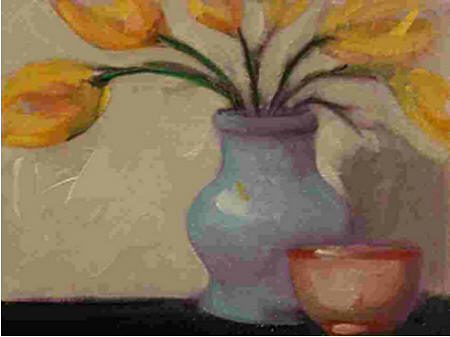
Yellow Tulip by Bob Martin
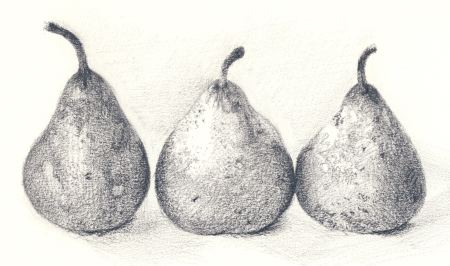
three pears by Hanneke van Oosterhout
I’ve been reading Fernando Pessoa, the quite unusual Portuguese poet. I really like the following poem from “The Keeper of Sheep,” translated by Richard Zenith.
Sometimes, on days of perfect and exact light,
When things are as real as they can possibly be,
I slowly ask myself
Why I even bother to attribute
Beauty to things.
Does a flower really have beauty?
Does a fruit really have beauty?
No: they have only color and form
And existence.
Beauty is the name of something that doesn’t exist
But that I give to things in exchange for the pleasure they give me.
It means nothing.
So why do I say about things: they’re beautiful?
…
How hard to be just what we are and see nothing but the visible!
Are the two works above about just the visible, or more than the visible?
Posted by Birgit Zipser on March 16th, 2007
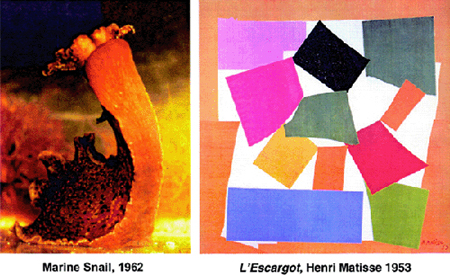
Abstract versus representational painting: here are some some thoughts on this topic by Eric Kandel, an old colleague of mine, and Sarah Mack.
While artists are now wondering whether they are doing something important, scientists are all talking about art – Margaret Livingston, V.S Ramachandran, Robert Shapley and, as discussed here, Eric Kandel. Neuroscientist have invented the new discipline – neuroesthetics. This trend of neuroscientists getting interested in the arts reminds me of an earlier trend when molecular biologists, such Francis Crick, switched to the neurosciences.
Eric Kandel with his interest in learning and memory, studied a form of learned fear, in Aplysia, a seaslug, for nearly three decades.
more… »
