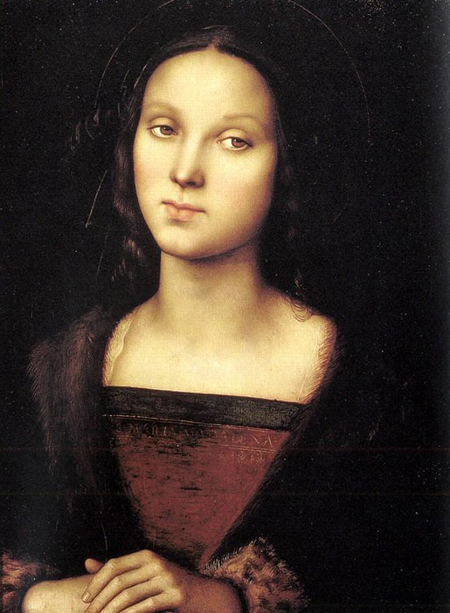
Mary Magdalene by Pietro Perugino, Pitti Palace in Florence, Italy. more… »
a multi-disciplinary dialog
Mary Magdalene by Pietro Perugino, Pitti Palace in Florence, Italy. more… »
Painting From Life vs. From Photos
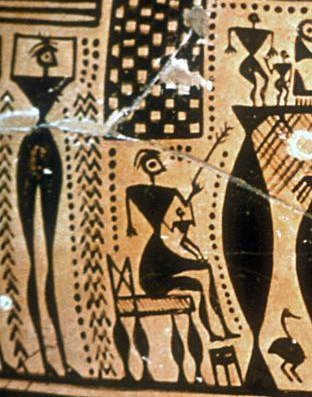
Detail from funeral pyre scene on an Attic Geometric krater, second half of 8th century BC
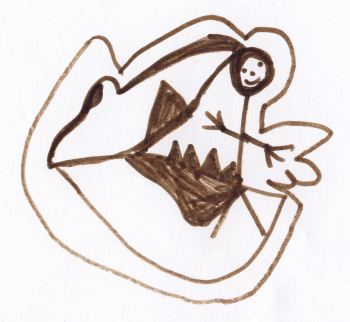
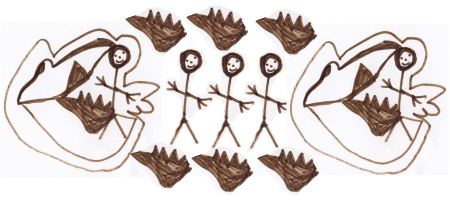
Man being eaten by a crocodile, first half of 21st century AD
The ceramic painting above I borrowed from Victor Bryant’s excellent ceramics website. The drawing on paper is by Fran, who is almost five years old.
The images are similar in that they both depict narrative scenes, and both make use of simple geometric shapes. The vase painting probably represents top quality artwork of its era, making use of a consistent representational system which covers this large vase and many others (presumably painted by many different adults working over many years). The children’s drawing is a one-of-a-kind sketch.
At first glance, the vase painting seems like children’s art made by adults. A key factor that distinguishes the adult work is the consistent repetition of patterns — across the detail, across the vase and across the historical period. There is a discipline here that is alien to the work of a child drawing as play. This use of repetition has substantial advantages. It imparts rhythm and complexity to the work that is lacking in Fran’s image. Repetition creates a decorative effect that masks to some degree the simplicity of the representation. For the sake of comparison, we can apply repetition to Fran’s image:
We can also isolate a figure from the vase painting. With these simple digital manipulation we have not transformed Fran into an Attic geometric vase painter, or turned the vase painter into a child. We have, I think, narrowed the gap.
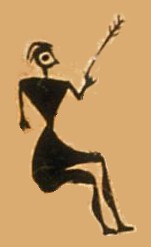
What I think is interesting here is that what presumably passed for fine work in the 8th century BC probably could be made by children, if they were compelled to work within a disciplined productive system (as the adults were).
Discipline and rigid compliance to style are factors that are quite contrary to our modern notions of art, however. Is the ancient vase painting art, or is it nothing more than systematized children’s decoration?
Painting From Life vs. From Photos
The only thing worse than being talked about is not being talked about.
—Oscar Wilde, The Importance of Being Ernest
Has art dealer Edward Winkleman become a cultural icon? If so, it seems we should pay attention to what he is saying . . .
” …There are two prominent myths about photography: the myth that it tells the truth and the myth that it doesn’t.” This quote, from artist Jeff Wall, is from a deceptively small book with some big ideas, “Photography: A Very Short Introduction,” by Steve Edwards. The semiotics of photography has never had such an accessible vehicle as this book, which is largely the structure of it: the nature and meaning of the photographic artifact and act. That tension between truth and artifice, across the duality of documentary and artistic intent, has existed from the beginning of photography and before, and still confounds us. There is no one answer, only paradox and ambiguity.
Thanks to J.P. Caponigro for turning me on to this wonderful book. There’s a deeper look into the book over at “Politics, Theary and Photographs.”

I’d like to describe a collaborative experiment that started from recent attempts to use simple image manipulation to aid in discussing visual art, such as painting (see comment 6 here) or fiber art (comment 12 here). Quite a few artists these days work partly or wholly digitally, and I wondered whether some of the advantages (like Undo!) could be carried over to an otherwise non-digital workflow.
In one of the posts mentioned above, June Underwood described her huge, inspirational, and ongoing project at John Day Fossil Beds National Monument. I proposed to cast myself as her assistant:
A recent post generated some discussion as to the relevance and status of political art on this blog and in society in general. I found this to be odd. Odd because in my view art is by it’s very nature political, inescapably so. In fact “political art” is almost a redundancy.
What is art? Artists, philosophers, historians, politicians, theologians, decorators, designers and investors have been debating this question since the invention of approval and disapproval. Webster defines art as”the conscious use of skill and creative imagination, especially in the production of aesthetic objects.”
While I comfortably accept Webster’s simple and elegant definition, in my view art is also the ultimate exercise of freedom and therefore the most political of statements possible. Every time an artist captures and reinterprets light, words or sounds, he or she is making a political statement. All art is political.

Artists can be divided into two categories: the honest who are true to their own aesthetic vision and muse and the dishonest who are not. Honest artists are anarchists and the most dedicated of libertarians. Dishonest artists emotionally and intellectually compromise their work in order to satisfy societal norms, commercial interests or peer pressure. But in either case, the product is a powerful political statement either supporting and furthering the politics du jour or expressing opposition. Both types of artists can produce great work. Honest artists like Van Gogh and Pollock and dishonest artists like Picasso and Warhol are good examples. I admit this differentiation is not so easily defined. Was Warhol paying tribute to commercialism and worshiping at its alter or was he satirizing and mocking it? Did Picasso mass produce art out of greed or are 50 versions of the same line a creative act of brilliance?
All of that aside, I believe that great artists are absolutely true to the themselves, expressing their inner vision with brutal and uninhibited candor regardless of the cost. And how can that be seen as anything other than a political statement?
Our old friend Webster defines “freedom” “as the quality or state of being free; as in the absence of necessity, coercion or constraint in choice or action.” Is that not also a definition of art and the process of its creation?
What act or set of actions in any society better exemplifies freedom?
Art is one of the first victims of censorship and persecution by dictators, authoritarians, totalitarians and theocrats. Few people or groups are more threatening to such systems than an honest artist. And dictators, theologians and corporations pay a premium for the dishonest artist who will create art in the furtherance of the cause or religious belief.
In a world where corporations, governments and organized religions spend trillions of dollars to control our perceptions and define our political, social and moral behavior, how can art not be seen as the most profound, challenging and liberating political statement of all?
As an artist, if you are true to your vision and true to yourself in the creation of your product, you are creating political art and making a bold political statement simply through your commitment to yourself and to your own muse. One need not depict an obvious political subject to create political art, one need only remain true to one’s self.
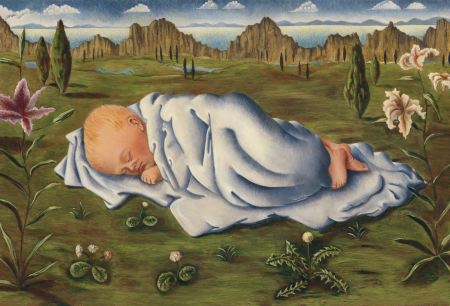
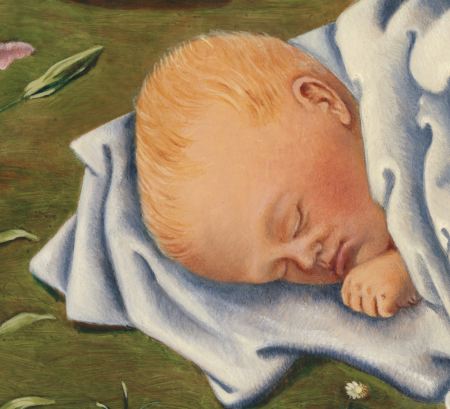
This painting of Françesca I made when pregnant with Nino (Fran was one year old then). We were living in Germany and I painted only an hour or two each day because I was too tired to sit longer (I was really big at that point).
It is based on drawings of Françesca sleeping, combined with my imagination. I find it wonderful to paint people.
Before I committed myself to still life painting I was working together with Karl using his rediscovered techniques of the old masters.
That is how I learned to use the different layers of paint in a simple and logical way.
I used to paint from my imagination, now I seem to have left that behind. How do you balance between reality and fantasy in your work?
. . .
