Posted by Steve Durbin on January 9th, 2007

In a recent post, Hanneke showed us a beautiful pencil drawing of three pears. In the comments, she and Karl expressed interest in comparing this drawing with a photograph. I decided to experiment along these lines, and above I’ve posted a first result (click on the image for a larger view). I plan to vary a number of factors involved in creating the image; you can help me decide what would be interesting to try.
In this first effort, I used one of Hanneke’s tricks: a dark background. The pears were ones I happened to have in the house, and are different from Hanneke’s, not as nice in shape. I used a similar arrangement to hers, with natural illumination from a nearby window. I’m not thrilled with my composition, but I didn’t take much time, and I can do a better job when I come back to this. Please give me your thoughts on things you like or don’t like about the composition.
more… »
Posted by Karl Zipser on January 8th, 2007
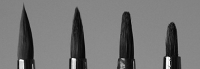
How to Care for Brushes
- Turpentine Trouble?
- Storing Brushes
- Cleaning Brushes
- Shaping Brushes
- Transporting Brushes
I have been doing pretty well with my New Year’s resolutions: to draw, paint, sculpt and photograph each day. Part of the key is to make the energy barrier for each activity as low as possible. With painting in oil, an important consideration is, how to clean my brushes?
Here is what Cennino Cennini wrote (probably in the 14th century):
. . . have a plate of tin or lead which is one finger deep all around, like a lamp; and keep it half full of oil, and keep your brushes in it when idle, so that they will not dry up.
In Cennino Cennini’s time, artists did not use organic solvents for oil painting. To keep their oil painting brushes from drying up, they stored them in linseed oil. A slight improvement on Cennini’s method is to have the hair of the brush in oil, while the handle remains oil free.
The advantage of storing brushes in linseed oil is that it is easier and faster to clean them. The painter does not need to remove the oil, only the pigment.
How do you clean your brushes?
Posted by Rex Crockett on January 6th, 2007
Well, it’s very difficult to post today. I’ve been too busy drawing to write very much; furthermore, I can certainly not manage handling any comments. I’ve hardly had time to comment on anyone else’s post for the past 48 hours. For example, Leslie wrote an excellent post on artistic changes of opinion, and I’d love to chat on that most interesting topic, but it’s no use. When it comes to a choice between the talking, whether on the internet or in person, or art, the talk goes.
more… »
Posted by Hanneke van Oosterhout on January 6th, 2007
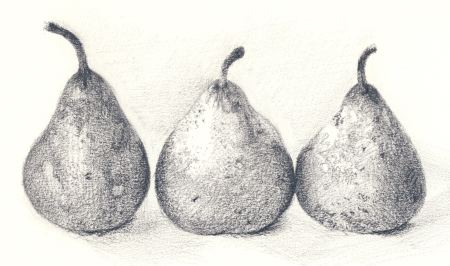
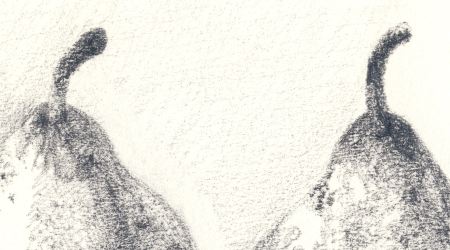
I decided to start drawing again on a serious basis and I today I wanted to try to capture the texture of these pears. I wanted to see if I could make come out in the drawing the complicated texture these pears have. I think got some of the feeling of these slightly shrunken and beaten up pears. The challenge is to capture that without paint. I wanted to see if something that I could paint I could also do it in pencil.
Posted by Leslie Holt on January 5th, 2007
I used to hate artists who refer to art historical images, whether through appropriation or more subtle reference. It struck me as elitist and dull. Why don’t they make their own images? And aren’t they attracting a really limited audience? But now I myself have started a new series with the aforementioned dreaded art historical references, and I am fascinated with other artists who do it.
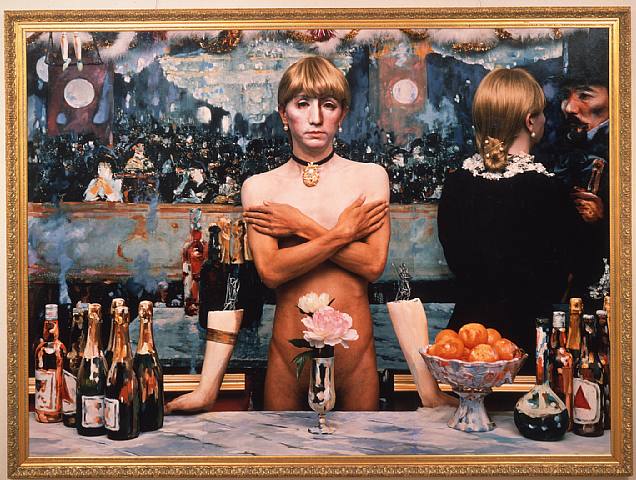
Yasumasa Morimura is a Japanese artist who recreates scenes from famous paintings and inserts himself in the “protagonist” position. His end products are photos in which he pretty faithfully reproduced the painting, but with himself in it, often as a woman.
more… »
Posted by Karl Zipser on January 4th, 2007
Is children’s art “art”? Steve said that age does not matter; Derek, June, Bob and Arthur were ambivalent. I thought I should ask a Françesca (four and a half years old) for her opinion about what she makes, and also about work by “grownups.”
more… »
Posted by Bob Martin on January 4th, 2007
For some of us, resolving a painting is more difficult then it should be. Once started, I am not able to see what I am doing with a clean mind. There are elements that I fall in love with a try to work around them, but never seem to get the entire painting to work. Recently I discovered that a painting that was testing my identity as an artist (another way saying, gave me great doubts about my ability) only needed for my scrape out the one thing that I thought was working for me, in order for the the rest of the painting to come alive.
Occasionally or almost always, the paintings become overworked. Knowing when to stop is a good thing. I have tried all of the little tricks you can use to play with your mind, like hiding the painting in a closet for a week, the black mirror, turning it upside down etc. Anybody have any other ideas?

