Posted by Arthur Whitman on January 3rd, 2007
Looking Down
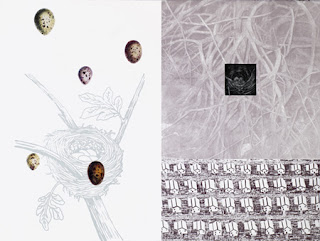
Nesting Instinct
From my latest review:
Taking a look around “Garden: Delights and Detritus” – a show of artist’s books, drawings and mixed-media prints by Ithaca College professor Susan Weisand – one is immediately struck by their visual eclecticism. Weisand’s work uses a wide spectrum of techniques and materials, typically combining several to create a single image. Similarly, she arranges, layers and re-uses different motifs and styles in a collage-like manner, giving her seemingly timeless natural subjects a distinctly contemporary feel.
More here.
I would appreciate any feedback on my artwriting.
Posted by Steve Durbin on January 2nd, 2007
 On the last day of 2006 I made several pictures of grasses in the snow. They were in a field near the woods I’ve been frequenting for my series of Sourdough Trail photographs. Although that series is concerned with complexity, at least in part, the grasses were classic studies in simplicity.
I feel that I am as much drawn to minimal subjects as complex ones — certainly when it comes to photographs I would like to own — but few of my own images are minimalist ones. Is it possible to encompass both complex and simple images within a single, coherent style? Or do they represent ways of looking at the world that are too different? If you saw both kinds of images in the same show, would you sense that the artist did not have a “mature vision”? Do you work in different “styles” at the same time?
Posted by Karl Zipser on January 1st, 2007
Painting From Life vs. From Photos
Thanks to my New Years resolutions, I took my camera on my walk this morning. Making photos every day — what’s the big deal? Photography is just a matter of pressing a button, right?
I did the same walk around the harbor that I do every day when I am in Wilhelmshaven. But today I felt exhausted afterwards, and it wasn’t from the physical weight of the camera. I felt tired because I used my out-of-shape “photographic vision,” a special way of looking at the world through a camera. It took about half an hour of walking and shooting to get into “photographic vision,” and it now persists for some time after I put down the camera. “Photographic vision” lets me take photographs without using a camera, in a sense. I assume all the photographers have this; probably the professionals live with it all the time. For an amateur like me, it yields a sort of “mental muscle ache,” something like what you feel when you first start exercising muscles that you didn’t realize you had. All the more reason for the daily workout!
Posted by Karl Zipser on January 1st, 2007