[ Content | Sidebar ]

Archives for Uncategorized

What Makes Good Landscapes?

I would like to hear what this group of artists believe makes good landscapes. Is there a feeling or something that words can explain, or not.  Should people be placed in landscape images? Is their presence necessary to make better art than without them?

In the last ongoing post, David mentioned “The main thing that stands out to me is the absence of people”, this hit me as being very profound.  I immediately ran to look at my work, and sure enough, I had nearly totally failed to put people in any of my landscapes; when I did, it was unconscious.  The only time I paint people is when I paint people. This is odd to me now, (what have I been thinking?), it seems so obvious to want to include something as familiar as people in a work to make it more inviting to the viewer, they could perhaps bring attention to something being performed. At what point however, would a “landscape” painting become a “genre” painting? Does it matter? I would like to know what quality you may feel is most important and should be included in most landscapes.

Cheers 


Tell me what you think

I’ve been working on a project.  I’d like folks to look at it and give me feedback.  Apropos of my comment about critiques of single works that need to be seen in a larger context, you have a chance to look at just shy of 90 photos. 

Before you look, some information that may be helpful.  The project is open ended – rather than having a definite goal in mind, it’s loosely organized around several goals.  I’m happy to discuss the goals, but I’d like to get some feedback from you all first.  There’s no significance to the format on my web site other than it’s convenient for me, the pages download in a reasonable time, etc.  Likewise, the order of the images isn’t meaningful to the project; they’re just presented in rough chronological order. 

So I’m interested in having people look at this bolus of photography, and tell me what they think.  Comments on individual photos, comments on the overall collection, comments on the overall direction of the project, or changes in direction you see as you browse through – those are of great interest to me.  Comments like “You should use this cool slideshow flash applet to present the images” are of less interest to me, primarily because the web is a view of the project seen through a glass, darkly.  The real project is a set of prints, 15″ x 20″ image area, intended to be overmatted out to 22″x28″ and then framed. 

One of the things that’s really helpful to me is seeing your questions – any questions. The title of the project, ‘sdg’, is significant but not something I’m prepared to discuss just yet.  Other than that, though, anything is fair game, ranging from technique and technical process all the way through to motivation, goals, whether I’m trying to communicate or not, the technical or artistic quality.

What I’m really hoping for, here, is more than just making this post and getting some comments and having it end with this post; I’d really like to start a conversation with several of you that goes on and on and helps guide the project as it evolves.

The web page of the project is at http://www.butzi.net/galleries/sdg/sdg.htm.

Artist’s statements

I’ve never needed an artist’s statement professionally. Probably I never will – I have no ambition to do the sorts of things that require them. However, if I did need one, I know I would have great difficulty in getting away with my working statement: This is what I saw. Even if I stretch that out into longhand – these photographs are representations, to the best of my ability, of what I saw – I only get to fourteen words.

I’ve updated my photo home page.

I’m writing about this again now, because I was recently asked by Lisa Call to explain what I meant when I said “art isn’t about communication. I am trying to communicate nothing. This is just what I saw.” Specifically she said “Colin could you expand on these comments? It is what you saw – but you put it here for us to see and to react to. Isn’t that a form of communication?”.

Now, I’ve had enough debates about the communication thing to know that, er, some of you disagree with me (one part of the debate is archived here, and I wrote an article which is here). I’ve no particular desire to go over that ground again, because it seemed to me that it was a matter of belief, and beliefs are not challenged by arguments. What I want to try to do here is to answer Lisa’s question in practical terms.

It is a fair question. If I’m not communicating when I put one of my pictures on display, then what am I doing?

I need to invoke a level one cut-off. I am saying here is a photograph. I think that that is about as uninteresting as communication can get, and even if I didn’t say it, the photograph would sort of say it for me. Please ignore this level.

What am I doing?

My photo home page has contained the following statement for some time: “I’m showing them to help create a dialogue, and with the hope that they may raise a smile, create an understanding or just generally do some good, some how, some where.” There are two parts to this, which I’ll deal with in reverse order:

a) smiles, understandings, and good: this is the altruism motive. I go to places like this every day for enjoyment. You post. I post. We both smile. I don’t think that this needs further explanation.

b) creating a dialogue: this is the potentially confusing area. I want to hear what you think about my photos. Not whether you think that they are sharp enough or whether the sky is blue enough – there is a place for that, but web reproductions aren’t usually worth the effort. No, I want to hear about what they make you think. I do this for purely selfish reasons, because some of you, some times, think something that adds to my thoughts and allows me to see better in the future. This is actually at its most interesting when your reaction is very different from mine. When there is no obvious flow between me seeing and creating, and you reacting. You have my attention the most when you have seen something that I didn’t.

If Winogrand is right and photos are new facts then they are interesting special cases to practise seeing on. If I can’t see what you can see in the photograph then I have to ask myself why? And is it interesting? It is much more difficult to have the same conversation about the real world. It is too big and we might not be looking at the same thing. Observation changes reality’s cat. Time creates difficulty. Things change whilst they are being described. On the other hand, photos are dimensionally limited. They don’t react to being observed. They do not change signficantly during a viewing period. And my photos are something that I think that I’ve looked at. That I think that I understand. Show me a new way of looking at them and boy, am I interested. I’m learning.

There are a couple of subsidiary things going on. I’m one of those human being thingies, so like everybody else I get high on random praise. Getting a few ‘the best photo ever’ comments never did anybody any harm.

I also use my photos as gateways to communication. Here I am on Photostream and Art & Perception (dual posting) talking about stuff – both through the comments and by email – with dozens of people that I’ve never met (it is sometimes slightly spooky that the conversations are overheard by quite so many thousands of you, which is why my email address is so freely available). The communication is about art. Not the other way around.

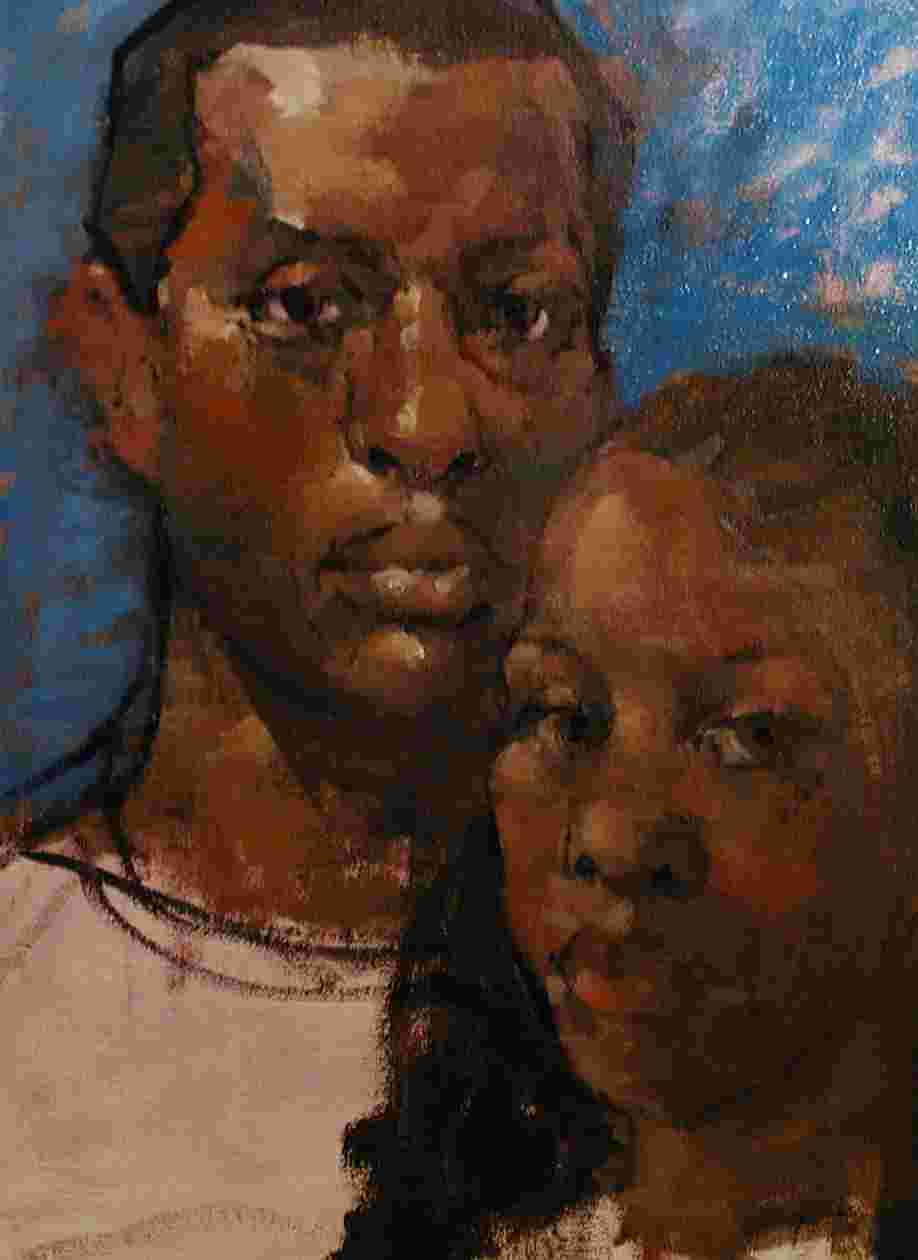
And I Was Just Helping Out.

I recently volunteered some advise on how to solve a painting problem to one of our fellow bloggers. Before hitting that submit button I re-read what I had written and in that crazy way we have of talking to ourselves, I said why don’t you follow your own advise.

This is a study I started as a result. I am trying to let the different colors create the form in the faces, eventually losing most if not all of the drawing lines. The other issue I am looking to work out is the merging of the two heads

Study for two heads

Where am I?

Sorry for not posting earlier (I’m a very late riser), and thank you Lisa for your impromptu post. I know that some of you readers also follow my own blog, The Thinking Eye; for those who don’t, I’d like to briefly introduce myself. I’ll do so by following up belatedly on Karl’s Monday post, trying to get at some of my writerly goals and biases by way of my location. Since I also spend time on the Internet (a sort of place, perhaps), this makes a good companion piece to my recent off-site post on Art & Perception. From September of last year, my home has been Ithaca in Upstate New York.

Although I like to discuss Ithaca on my Eye and elsewhere, it often seems absurd of me to do so. A city of something like 50,000 people (the population varies with the coming and going of students), it is not, and has never been, an important art center on the order of Haarlem or New Amsterdam (although it was of some significance in the early film industry). Most likely, it will never be one in the future. Ambitious artists around here tend to gravitate towards NYC, which is about a six hour drive away. I like to travel there myself, as much as I can. Still, Ithaca is where I live, and it effects the way I think and experience art. (I live here by choice, so I try not to sound like I’m complaining too much.)

As a college town–home to Cornell University and Ithaca College–the place is hardly bereft of culture. In fact, it is something of a miniature melting pot, a mixture of different nationalities, religions (a major center of Tibetan Buhddism), and art-forms (music being much stronger than the visual arts). Unfortunately, most of the culture that I value most is not native-grown, but imported. Cornell’s Johnson Museum has a fine a fine permanent collection of art, with particular strengths in in Asian and American art. In addition, the museum and other branches of the school brings in a wide variety of exhibitions, artists and scholars. I try to take in as much of this as I can, digesting interesting bits through my writing. The problem is that most things of interest art-wise come from elsewhere, and are funneled from the top down. This presents problems for me both as a (lapsed) artist and as someone interested in writing seriously about art. I’m working on the latter, at least.
I moved here from Boston last year (mostly for personal reasons) after completing several years of undergraduate study at the School of the Museum of Fine Arts. My final year there was spent at Tufts University (which is associated with the SMFA), studying things other than studio art. Because of this time period, and because I felt (correctly or not) that I had used up a surge of ideas beginning in 2001, I have shifted my attention from making art to writing about it. While many artists seem to regard this as a waste of time, I believe that it is valuable. If nothing else, I am good at it.
Karl’s claims that “the action in the great living art centers of today is not all that impressive”, citing New York, Berlin, and London. I would like to politely disagree. I have never been to Berlin or London, but I have been to NYC, Chicago, Boston, Washington D.C. and Paris, among other places. While I’ve seen plenty of bad art, I’ve also seen a great many things of interest (to me, Karl’s tastes are clearly very different). My main interest is not in the art of the past, the kind enshrined in museums. My main interest is in the living arts of today: not because I think we’re living in the greatest of eras, but simply because the culture is active. I enjoy being in the midst of this culture.

Eventually, I plan to move to New York; in the meantime, where I am is alright.

Youth, love, eclipse and snogging

Recently another student doing a school project at the University of Southern Indiana was comparing one of my works to a Salvador Dali painting asked me to give him some insight on the meaning of “The Eclipse”.

“The Eclipse of Love” (complete title) is one of my early works. It is one of my most romantic sensual pieces… My work is personal and about my life experiences at the time. The idea of this painting came from a sketch I made in the summer inspired by the total Eclipse of the sun (Aug 1999).

At the time, husband and I were starting our romance and would spend hours of tongue rolling and strolling in the park under the trees. In 2001 when we moved together I decided to make a painting of this idea as a reminder of how our relationship started. It’s hanged in our bedroom since.

I would probably sell many of my paintings but this one is the one I am mostly emotional attached to. This student after examining my painting “The Eclipse of Love” to Dali’s “Cannibalism in autumn” found out that they are very similar in his opinion. But the main difference he found was that I was expressing love while he is expressing death… Any thoughts??

What is the Art of the 21st Century?

Nearly seven years into the 21st century and there is no one recognized “art movement” for this new age. The 20th century saw many attempts at changing the status quo, and shaking the art world loose: perhaps beyond repair. Despite all the art movements of the 20th century, a few held on and many gone. There are two art genres however, that have been steadily gaining more attention across the world. While not exactly new genres, there is a freshness being breathed into “plein air” and “conceptual” style art, popularized by artists like Howard Pyle.

Plein air was popular in the late 19th, and early 20th centuries, in recent years it has become renewed for both the skill required to participate, and the public festival atmoshpere it creates in the communities where they are hosted. Another popular standout today is “conceptual” art, this style is being fueled by a new generation of computer savvy game designers and their need for graphics and background scenes. Inspired by great illustrators, and 30 years of “future” based T.V. and movies, this “new” art form is responsible for scenes one might see in movies like “Star Wars” or “Dune”. The unique thing about this art is the inventiveness and imaginative capacity required to create it, artists are literally creating their own worlds based entirely on conceptual imagination. I believe that both these artforms will continue growing in popularity, “plein air” for it’s ties to classicism and the adroit skills needed to capture an essence, the other for it’s ability to delve into the creative depths of imagination. In similar fashion to Jules Verne or H.G. Wells, these “conceptual” artists may inspire through their works, new ideas in the minds of engineers that could indeed become reality.

Does anyone have any ideas about the direction art is heading in the 21st century? Are there art movements that are sweeping your area? What type of art will children born today be influenced by as they grow older?

css.php