[ Content | Sidebar ]

Archives for Uncategorized

Compelling Fiction

Arthur, in the comments to this post, wrote

This is so, I think, because great (or even merely good) art is not primarily concerned with presenting literal truth. (This is more the role of science and philosophy). Rather, the role of art is to present compelling fictions. By “fiction”, I don’t mean necessarily a conventional narrative. I mean that works of art create their own worlds, with their own rules.

Robert Adams expressed some thoughts that I think are related to this in his book Beauty in Photography.  First thought – “The job of the photographer, in my view, is not to catalogue indisputable fact but to try to be coherent about intuition and hope.” And the second thought is “There is always a subjective aspect in landscape art, something in the picture that tells us as much about who is behind the camera as about what is in front of it.”

It seems to me that quite a lot of landscape art (painting, sketching, photography) is not so much about presenting a compelling fictional world, separate from reality.  It’s about presenting a glimpse into how that reality is seen by the artist.

I’m not sure if that’s agreeing with Arthur or not.  But I think Arthur’s got a fascinating insight, and I’d sure like to see more discussion along those lines.

(photograph above not particularly relevant to this discussion.  I just think the blog looks nicer with images embedded in the stream of posts.)

The Universal Survey Museum

If anyone in any western part of  the world wants to look at historical works of art of universal truth, visits a museum. Museums collect and care for scientific, artistic, historical objects of importance and display them for public viewing through exhibitions that are either permanent or temporary. Unlike art galleries, museums are usually not run for the purpose of making a profit but to provide historical education to the public. No other place has the wealth and the importance of a museum and its arts that can draw the attention of millions of visitors every year.
The national museums for instance are design to remind temples with its monumental distinction. The stairs are elevated from the ground to give rise to the culture and the high ceilings and columns resemble an Ancient mythological sanctuary. This architecture is designed and studied to make an impact in our perception and change our behaviour as just in temples, churches, palaces and places of worship.
Museums exemplify the idea of state by following the roman architectural style to symbolize authority. The contents are not displayed randomly, the structure of how things are organized, layout of the rooms and works related to each region are super imposed, making the viewer independently of age, education or class to walk as if in a ritual. The works of art stand as adorned pieces just like in sacred ceremonial monuments, and are displayed chronological as teaching the evolution of its history. Art is displayed as a progress that comes from a gradual change; next evolution refines what previous generation has done. An individual piece of art in a museum for instance becomes an important piece in its historical relationship labelled by name and date. The different types of museums hold a vast collection of important selected objects of each field and have their different iconographic programme but the universal survey museums are the ones who present a wider variety of art history. These museums different from other kinds of institutions, are of peak importance and are meant to impress visitors and royalties that come from anywhere else in the world.
The royal art gallery and the public art gallery for instance were very different politically. The royal art gallery stand for the king’s possession while the public art gallery belonged to the citizens. 
The first public museum was the Louvre Museum in Paris in 1793 during the French Revolution allowing access to the royal collections for people of any status. The Louvre museum is one of the most important in the world and holds the most prestigious works of art.
This has revolutionized the experience of viewing art in museums through history by its open doors to the public. Anybody from any class or background can visit a museum and take as much from its intellectual wealth. Museums became as sites for educating the masses in taste and refinement until our days. Today, museums are as the most important places for educating children and adults, after schools and libraries, and one of the most reliable sources of information, more valued than books, radio, newspapers and the Internet. 

The Role of Art

In his book The View from the Studio Door, Ted Orland goes on at length about the function of Art in society.  In particular, this passage caught my attention:

Most historical artwork played a role in society or religion or both.  There’s pretty good evidence that Bach himself understood that to make work that mattered meant addressing art at every level – from the purely technical to the completely profound – simultaneously.  He once composed a set of training pieces whose purpose, he said, was “to glorify God, to edify my neighbor, and to develop a cantabile style of playing in both hands.”

Some version of Bach’s three tiered work order might be a worthwhile guide for artists working today.  Today most artwork is not part of something larger than itself.  It certainly isn’t within the art world, where the embattled but still dominant postmodernist view holds that artists are not even the authors of their own work – that there is no such thing as an ‘original’ piece of art, but rather that we make art by taking things out of their original context (i.e. deconstruct them) and reassemble them in a new context.  The idea that the subject of art is art may be a stimulating intellectual proposition within the art world, but it goes a long way toward explaining why most non-artists find zero connection between their own life and that same art.  How deeply can art matter if the only fitting description of its meaning and purpose is “art for art’s sake”?

I’m highly sympathetic to Orland’s view of things.  What do you think?

How to Critique Art. For some reason I have the answer

If a Tree Falls in the Forest Does it Make a sound? Only to the trees with ears. I am not at all being funny. Everything is dependent on a tuned in listener. When it comes to art, sometimes there is no one there, meaning that those who can or want to understand what it is that you are up to, are not in the room. There will be others in the room who find your work similar to learning that there is “only” broccoli left in the refrigerator to eat. (Sorry broccoli lovers). This is not the feedback you need.

When having your worked critiqued, here are two questions that need to be in the mix

  1. Ask the person who is doing the critic “What does this work (the art, what ever it is) mean to you?”
  2. Then ask “What does my work say about me?”

If the answer to number 1 is nothing, then by-pass 2 and go directly to finding another critic.

Now for some Turkey.

One art, or two?

Brooks Jensen’s podcast of November 16th makes an interesting point about the way that different artists work.

The tenor of his thought is that photographers tend to be less likely to be artists in other fields as well – in comparison with painters or sculptors etc. He is not claiming an absolute line here (please listen to the podcast), but a tendency.

I think he probably has something.

The question is ‘why?’.

What I’m about to say is riddled with exceptions and iffs and buts. I’ll try to deal with the major ones as I go.

Photography is a dramatically different art process from any artform where you start off with a blank canvas, a white sheet, or an empty space.

As a photographer I don’t build an artwork piece by piece. I don’t need an idea. I can’t dramatically alter a work once it has begun.

No, as a photographer, I put myself in positions where there is something to see. I subtract the things that I don’t want to include and then I press the shutter. Once I have pressed the shutter, 95% of the work is done.

This doesn’t mean that I can’t have a project in mind, or that I can’t have some thoughts about what I am doing in advance. But I can’t influence what there is; I can’t control to any great degree what will pass in front of my camera. I decide where to stand and when to press the button. This may explain our collective fascination with street photography. Is this the form of photography where the photographer has least control over what is in front of the camera?

There are photographers who work out in advance a picture and then work to create it. I’ve recently seen an interview with a photographer who can take months of preparation before getting to the camera work, and, even when shooting, will go days without making an exposure. I think such photographers are the exception.

I think that photography is most like the additive arts when still life photographs are involved. There is no great difference, I think, between the thought processes behind creating a still life painting and creating a still life photograph. I also think that the ‘clean sheet’ art closest to photography is drawing from life (or possibly watercolour painting). The production time is short enough, and the possibilities of reworking are limited enough, that the same ‘see and react’ process could be happening. Photography has been called ‘instant drawing’.

Brooks Jensen also noted, as an exception to his general view, that a considerable number of photographers have been musicians. I think that this makes sense. Musicianship is also an art where the important bit is in the doing. Not the thinking beforehand, nor the artefact afterwards.

The idea that such a large part of the art of photography has happened when the shutter is pressed makes sense of the observation that photographers don’t often show unfinished work for comment. Showing an unfinished work makes much more sense for an additive artform because somebody can say something that may significantly, rather than marginally, influence the final piece.

It also begins to explain some of the miscommunication about communication. If to begin an artwork you have to have an idea, then you are probably likely to bind that idea, in your mind, into the finished product.

So, photographers aimlessly wander around and randomly press the shutter button not having any idea in advance what they are trying to achieve……

Lots of people before me have said that ‘photography is about deciding where to stand and when to release the shutter’, so there is no credit to me in inventing that phrase. But it is a powerful one. Deciding where to stand doesn’t just mean ‘up a bit, down a bit, left a bit, fire’. It also means deciding where in the world to go and when to do it. But once you have done that you have to accept what there is. You can’t invent snow that has melted, or bring out a sun that doesn’t shine. You don’t create by adding. You don’t use your imagination, you use your eyes.

Whereas, if you start with a blank sheet, you can examine your idea and ask ‘is this an oil on canvas idea, or a linocut idea’ (or any combination you care to mention).

This is a very good description of what photographers do, whilst this is an incomplete, but nonetheless interesting, take on the f8-and-be-there serendipity mindset. By the by, the ‘f8 and be there’ idea is another take on the whole craft question – but that is for another time.

There are artists who are signficant photographers but who also are known in other art fields. Wright Morris was a novelist (I can’t explain that combination); David Hockney was a painter who did photography for a while (that is a much more likely way around for it to happen); Henri Cartier Bresson was a photographer who also drew (I think the phrase ‘instant drawing’ was his). Any more?

This entry also posted in Photostream.

The Hijacking of Meaning

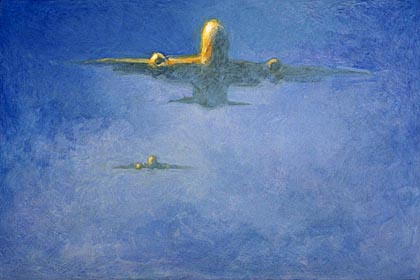
lax_07.jpg 

This is one of a series of 30 paintings that I did in the spring of 2001. The paintings were presented in a group exhibition here in Los Angeles on September 15th, just 4 days after the September 11th attacks (the show had been planned months in advance).

Where does the meaning come from in a work of art? Is it contained in the artwork itself, or does it come from somewhere else? Is it permanent, or can it change? How much control does the artist have over what is communicated by their work?

Mirror, mirror upon the wall…

Mirror mirrorTitle: Mirror, mirror

Size: 127x101cm

Oil on canvas

Fine Art University project


This painting has taken me 3 weeks working full time to complete. The still life is a true mixture of my occupation tools: motherhood and artist… 

My visionary portrait is a reflection of certain powers I possess since childhood… 

Please be gentle when you criticize me, bare in mind there are many mature artists showing their wonderful experienced work online while as a young artist I am still learning my own way…

css.php