I’ve always been somewhere between irritated and offended by Queer Eye For The Straight Guy. Did it perpetuate offensive stereotypes: the clueless lives-like-a-pig badly groomed straight man and the flaming nobody makes it as pretty as a poof gay boy? And then there is that nagging feeling–as it is with all stereotypes, that both stereotypes are built on a grain of truth.
Regarding homosexuality, the world seems focused on two very queer questions.
The first question suggests that homosexuals differ from heterosexuals in no other way than the sex act. Are we just like everybody else, differing only in our choice of sex partner? Or does sexual orientation, like gender, cause us to think and feel differently in many ways other than just sexual attraction? And is this particularly obvious when it comes to the visual and performing arts? Is there, in fact, a Queer Eye?
img src=”http://rjr10036.typepad.com/proceed_at_your_own_risk/images/2008/01/06/bret_and_stephen_070.jpg” align=”middle” />
The second question, of course, is the raging controversy: nature vs. nurture?
But there is a third “elephant in the room” question that is mostly ignored; Are gay men generally more creative than everyone else or is this one big fat whopping stereotype?
The compelling implication of the creativity question is that if the answer is yes and we are generally more creative and more sensitive to our environment, than the first two questions make no sense–unless you actually believe that talent is a chosen and subsequently learned skill.
Does Bravo Television’s Queer Eye For The Straight Guy play to an offensive Jim Crow kind of stereotype or do queer men bring a greater sense of style and taste to the physical world?
img src=”http://rjr10036.typepad.com/proceed_at_your_own_risk/images/2007/12/31/queer_eye.jpg” align=”middle” />
Do gay men naturally dominate the creative arts or are we simply more comfortable being out and loud in this more permissive and expressive environment? Have anthropologists, sociologists, psychologists and homo-ologists built a house of cards on a very false premise? What is the queer eye? Is the queer eye born of and nurtured by the closet? Obviously, our sexual tastes coupled with the repressed and confined boundaries of the closet drive a much keener awareness and sensitivity to human behavior and the environment in general. Visual details from color to hand gestures become much more important to the queer boy than to the straight boy. And survival is the driving force. The wrong hand gesture in an ordinary school yard can earn you a bloody nose. A pink shirt in high school announces “fag” to some, “pride” to others.
During very early stages of childhood development, queer boys necessarily become superior observers, consummate actors and very creative creatures. Even within your own family, you catch on quickly to the fact that you are seeing the world through different eyes than almost everyone else around you. Many artists will tell you that pain and “experience” are the greatest muses–and who feels more pain and has more “life experience” than a queer?
img src=”http://rjr10036.typepad.com/proceed_at_your_own_risk/images/2007/12/31/survivor.jpg” align=”left” />Obviously, the same cannot be said for other minorities–persecuted or otherwise. We are unique in that we are born a minority even within our own ethnic, cultural or religious minorities. While any queer Jew or African American will tell you that he or she acquired useful survival tools as a Jew or African-American that apply to queer survival, the queer needed to take those survival tactics and strategies to an entirely new level not even remotely imagined by his or her immediate blood family.
So let us ask another obvious question. In order to survive, the queer must call upon inner resources and behavioral skills not even remotely part of the lives of most heterosexuals. Survival compels the queer to hone senses and sensitivities far beyond the needs of the average mainstream heterosexual. Is that the fuel behind enhanced creativity and sensitivity? Is that the origin of the Queer Eye?
So here we are circling back to nature vs nurture.
And the debate rages on. One prominent thinker attributes queer creativity to a form of impaired maturation. Another suggests that homosexuality forges a stronger relationship between mother and infant, which some science now suggests may be the evolutionary basis of art. Does the disproportionate number of gay men in the arts suggest an unusual and extraordinary capacity to speak the language of maternal love?
Are we retarded (but in a loving way)?
Internationally respected scientist, artist and author (The Naked Ape) Desmond Morris, who became a bestselling author by applying zoology to explain human behavior, has now utilized the same techniques to put forward an explanation for homosexuality.
In his latest book, The Naked Man, Morris theorizes that men are “made gay” because they retain infantile or juvenile characteristics into adulthood – a phenomenon known as neoteny. img src=”http://rjr10036.typepad.com/proceed_at_your_own_risk/images/2007/12/31/desmond_morris_2.jpg” align=”right” />
According to this theory, gay men also tend to be more inventive and creative than heterosexuals because they are more likely to retain the mental agility and playfulness of childhood. Intuitively, that sounds and feels “right”.
“Gays have in general made a disproportionately greater contribution to life than non-gays,” said Morris, who is also a noted artist. “The creative gay has very much advanced Planet Earth.”
“The playfulness of childhood is continued with certain people into adulthood. This is very much a positive. Adult playfulness means that certain people, often a fairly large proportion of them gay, are more inventive and curious than heterosexuals.”
This new Morris theory has been attacked by Steve Jones, professor of genetics at University College London. “It’s arts faculty science to say that gays are neotenous,” he said. “It’s a stupid idea. Where is the real evidence?” more… »
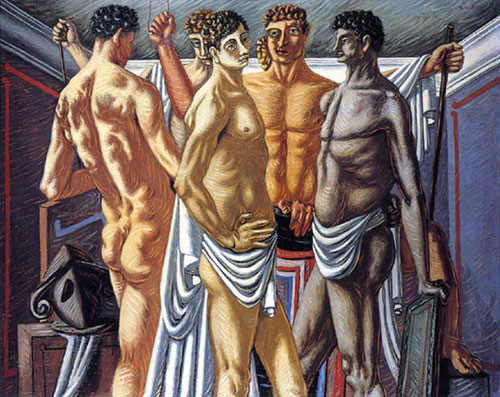 Gladiators at rest (gladiators au repos) 1928-29, oil on canvas, 157 x 198 cm.