Hat, oil on 12 x 16 inch basswood panel more… »
Studies of Sand in the Sleeping Bear Dunes
Sauce for the Turkey
It started out as a place to dry dipped sheets of paper. But the Foamula surface began to take on a life of its own. At first I contented myself with applying a mixture of gold paint and varnish in an effort to glue the whole thing together. After awhile it began to come across as needing something more. I’m trying to wean myself of an addiction to puddled and shiny surfaces – but just this one time…
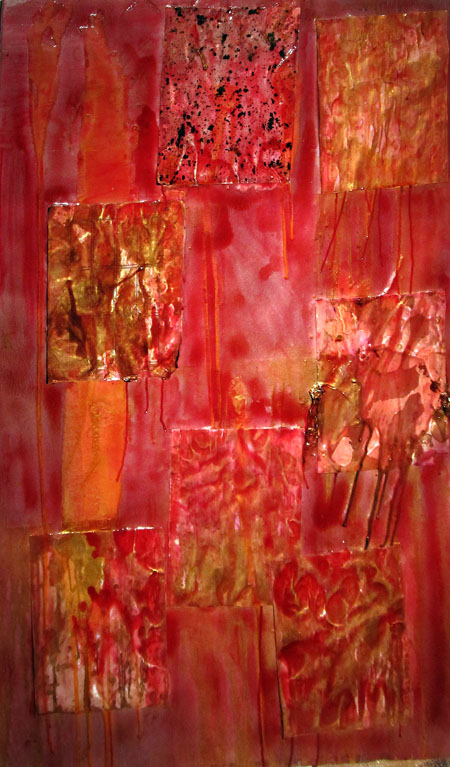
So, in the spirit of the season I got out some more varnish, mixed in some crimson and sploshed away. This is the first version.
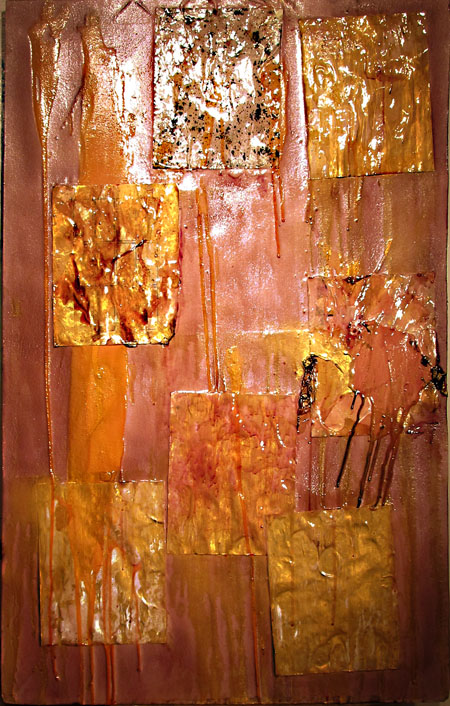
And this is the seasonal development.
Ebony and Ivory
The chain motif that appears in other posts here, continues to occupy me.
In this instance I am attempting to develop an idea of racial entanglement that goes back to one of my first inspirations for this series. The work in question is a piece of airport art from Kenya that constitutes a chain, carved from a single log, and featuring a head at each end. In fact, I took a swipe at making a version of such consisting of two ceramic heads, one negro and the other white, connected by an arbitrarily long steel chain. This chain, many tens of feet in length and rusted and worn, was to be draped over a remotely high and obscure support. The heads were to be at the same height from the floor and so arranged that they might collide with each other. I didn’t feel able to bring this off and the project pends.
Along similar lines is this: two separate and separately colored chains which follow their own trajectories, yet cross and entangle with each other.
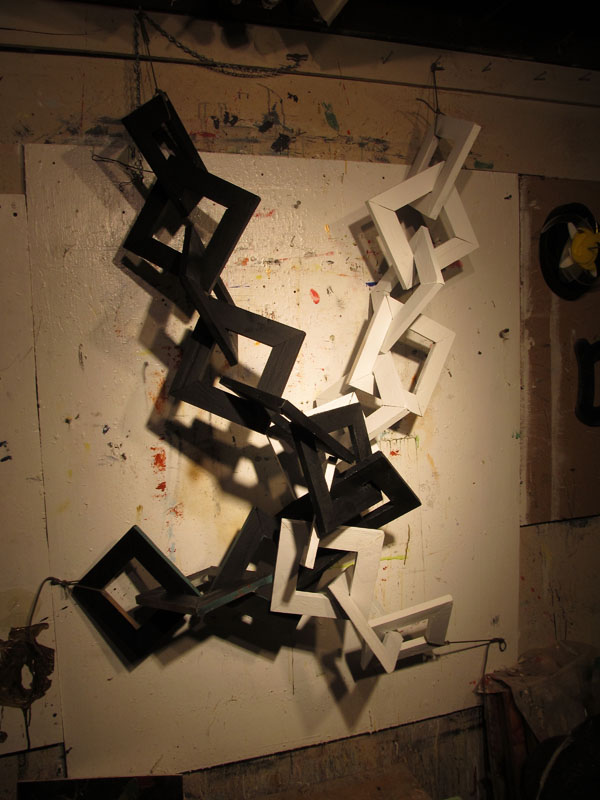
The rule is to not show an unfinished project, but in this case I’m making an exception. This because I’m looking for comment. For instance, does the layout say anything? How about the links?
Early Morning Sun in the Hudson River
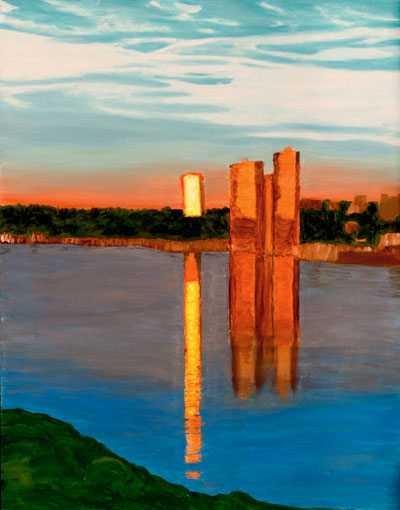
This painting captures the sunrise at the Hudson River in Manhattan. At 7:00 am, April 4th, the rays of the sun bounced off the buildings on the New Jersey side and then reflected within the Hudson itself. The early morning sun produced a different lighting than the midday sun in my Sleeping Bear Dune picture. In my Dune picture, the light across the picture is quite flat. Contrast is achieved by using bright complementary colors, red and green, blue and orange. more… »
Hot Day in the Dunes
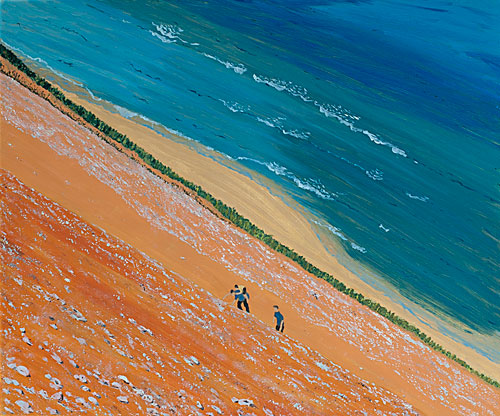
oil on basswood, 20 x 24 inches
Monet painted outdoors. A servant carried his paints and canvasses when he worked away from his house. At home, he diverted a stream to create his famous lily pond. A gardener kept its surface pristine, free of rotting leaves and insects.
Today, some painters work from photographs. Gerhard Richter painted from family photographs or obtained permission to paint from photographs in newspapers or journals. Peter Doig’s subjects, as FT.com puts it “ figures, buildings, landscapes – are stolen images (often carried around found for years on paper or in his head) knitted together into an imaginary world”.
Like other artists, I also prefer to paint from photos – recently, my own, while earlier, I made montages combining my own photos with images from the web. Enjoying hiking and photography, I now go out hunting for motifs that appeal to me. more… »
Out With It
” If I don’t want to exhibit the thing and if it cannot be re-used or improved, then I will throw it away.” Words to cull by.
Out of the corners have come some pieces of ill-used Foamula that have caused me to ask: “What was I thinking?’. However they often still possess a pink reverso, open to a further assault. This new onslaught upon the as-yet unslaught upon seeks to answer some questions regarding the application of polyurethane varnish. Before, this varnish was apt to dissolve the Foamula and required a preliminary coat of water-based primer or paint on the surface to prevent that from happening. Since then, the composition of the varnish – at least the stuff I’m using – has changed. Unfortunately the new formulation is of a brownish color and more expensive. Fortunately it now appears not to dissolve the Foamula any longer. The old veteran boards are being pressed into service to see if this is truly so.
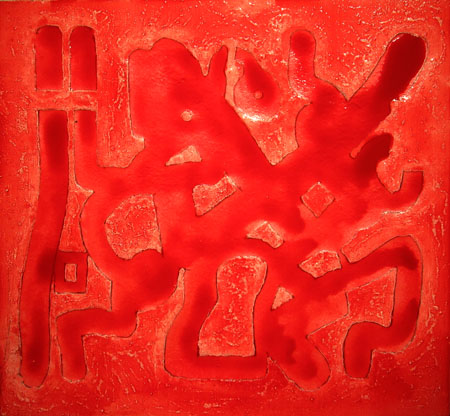
A design was drawn on the surface of this board and areas were blocked out with gesso, leaving the rest of the area bare. I then applied a hot air gun – the type used for removing paint. This caused the bare surface to shrink while the portions protected by the gesso remained relatively unaffected. I then tinted some varnish and spread it over the surface. It collected in the grooves and indentations with results that you can see. So far there have been no untoward effects.
Drawing in Soho
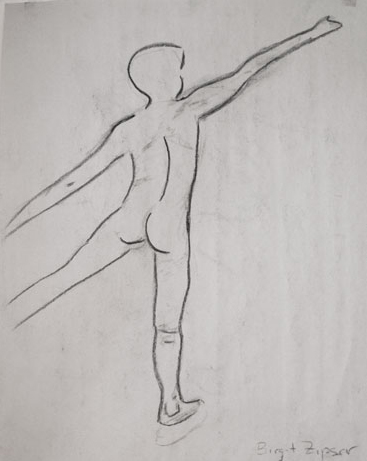
Thinking that learning to draw the human figure might help me drawing the soft shapes of Michigan’s Sleeping Bear Dunes, I took lessons at springstudiosoho.com for the last few months. With charcoal on a 24 x36 inch pad, I drew poses that were held from 1 to 20 minutes. For the 20th anniversary of the studio, the drawing below was exhibited. Minerva Durham’s comment on taking the picture was: ‘You have moments’ which made me feel wonderful.