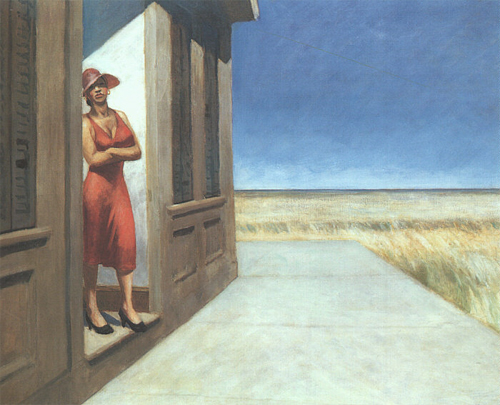
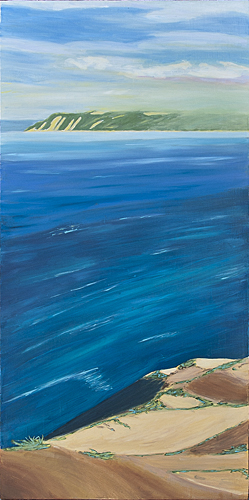
Hat, oil on 12 x 16 inch basswood panel more… »
Archives for painting
Studies of Sand in the Sleeping Bear Dunes
Early Morning Sun in the Hudson River
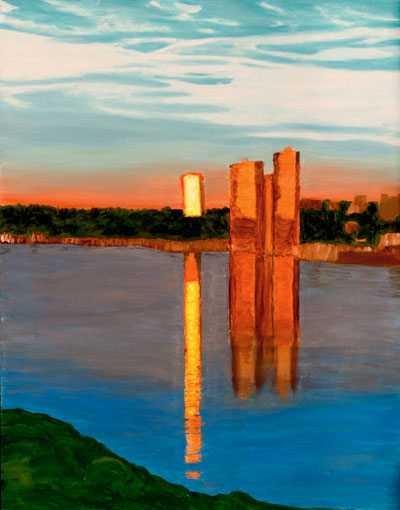
This painting captures the sunrise at the Hudson River in Manhattan. At 7:00 am, April 4th, the rays of the sun bounced off the buildings on the New Jersey side and then reflected within the Hudson itself. The early morning sun produced a different lighting than the midday sun in my Sleeping Bear Dune picture. In my Dune picture, the light across the picture is quite flat. Contrast is achieved by using bright complementary colors, red and green, blue and orange. more… »
Hot Day in the Dunes
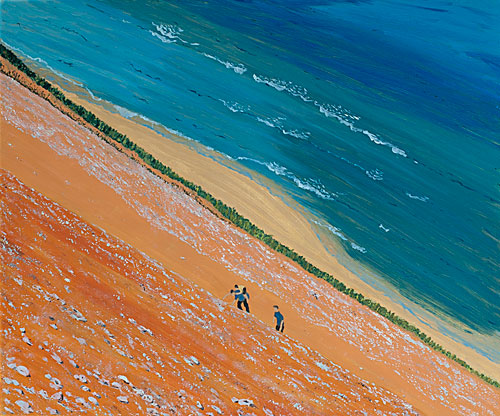
oil on basswood, 20 x 24 inches
Monet painted outdoors. A servant carried his paints and canvasses when he worked away from his house. At home, he diverted a stream to create his famous lily pond. A gardener kept its surface pristine, free of rotting leaves and insects.
Today, some painters work from photographs. Gerhard Richter painted from family photographs or obtained permission to paint from photographs in newspapers or journals. Peter Doig’s subjects, as FT.com puts it “ figures, buildings, landscapes – are stolen images (often carried around found for years on paper or in his head) knitted together into an imaginary world”.
Like other artists, I also prefer to paint from photos – recently, my own, while earlier, I made montages combining my own photos with images from the web. Enjoying hiking and photography, I now go out hunting for motifs that appeal to me. more… »
curved versus vertical
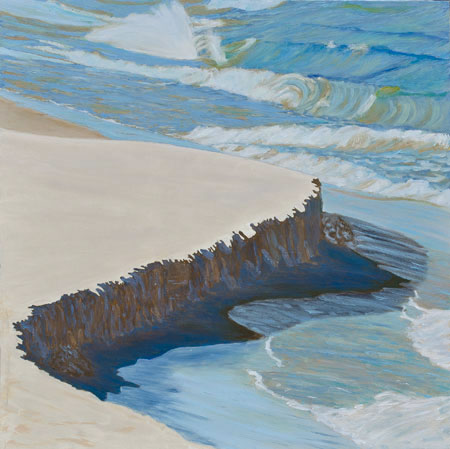
Sandy edge, 18 inch x 18 inch, oil on birchwood panel
Vertical seems to be an ephemeral property. A sandy edge molded by ice and waves will soon crumble. The jaggedness of the Great Teton Mountains will be replaced by rounded shapes demonstrated by the juxtaposed older Gros Ventre Mountains.
In much of the cosmos, there is a wealth of curved lines – the planets with their elliptical motion, our double Helix and the curvatures of our spine.
Why then is verticality inspirational with gothic and current architecture reaching into the sky?
3-D and Arial Views at NAMOC in Bejing
Paintings depicting 3-dimensional and arial views were abundant in an exhibition of current Chinese art at NAMOC, the National Museum of Chinese Art, in Beijing in March 2011.
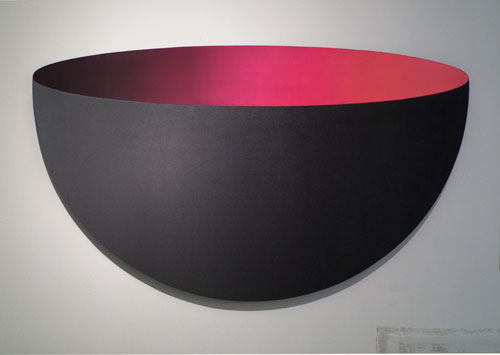
Cheng, Wen-ji, Embracing, 114.5 cm x 200 cm, oil on canvas, 2009
This bowl, seen from a distance across the room, looked startingly 3-D. We stepped close to admire its geometric perfection. more… »
Edward Hopper and the usage of incongruencies
The two paintings of Edward Hopper, shown here, are part of the current exhibition in the Whitney Museum of American Art: Edward Hopper and His Time. Much has been written about Hopper’s usage of light and shadow. I will point out his usage of incongruencies that further accentuates the sense of isolation and alienation that Hopper’s painting are known for.