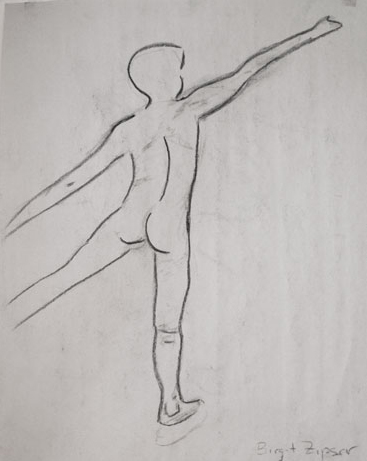
Thinking that learning to draw the human figure might help me drawing the soft shapes of Michigan’s Sleeping Bear Dunes, I took lessons at springstudiosoho.com for the last few months. With charcoal on a 24 x36 inch pad, I drew poses that were held from 1 to 20 minutes. For the 20th anniversary of the studio, the drawing below was exhibited. Minerva Durham’s comment on taking the picture was: ‘You have moments’ which made me feel wonderful.
Archives for from life
A Meditative Moment
I thought it would be nice to share some photos of the sky on the one day of the year when we have the most time to look at it.
I took a series of photos of the sky over a period of about three months quite some time ago and I hope to return to the subject again one day. I would love to see these printed large and on a wall for people to get lost in.
How many of us look to the sky for a message of some sort? Happy Solstice.
Post-Painting Depression
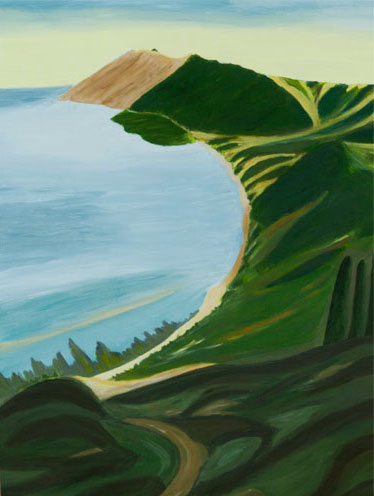
I’m back in Portland, Oregon, from my six-week Nevada sojourn. But I haven’t unpacked my big linen canvases yet. I am almost afraid to do so, fearing that they are completely banal, hence total failures (banality is worse for me than bad).
In part, this reluctance has to do with various coming home challenges — burst pipes, unreliable contractors, relatives using the house in unexpected and unnerving ways. But in part, it’s simply because I don’t know what I did, although I am fairly certain I did not manage to un-orient, and my feeble attempts merely feel like they may be so feeble as to look feeble-minded.
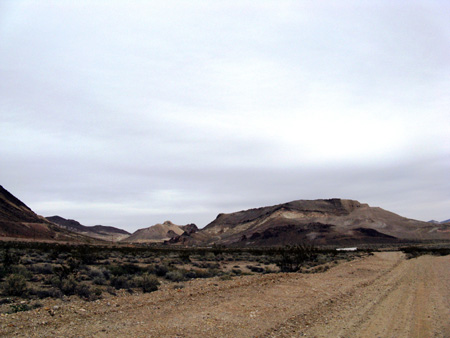
Well, you see where I am. I began last February and March, 2009, living with the desert and Beatty, Nevada, painting small masonite panels, getting to know the territory and its inhabitants. This November sojourn, however, was more limited and almost entirely devoted to the Amargosa, which became more and more fascinating as I spent 6-8 hours a day, alone with the scene, for the full month of November.
So here are photos of the seven panels, plus the full panorama. These were taken as the panels were still on the wall of the Red Barn, under under limited lighting conditions. The exception is the full panorama, which was lit andphotographed by professional photographer, David Lancaster.
I am showing these in part to bolster my own sense of dignity and/or bravado.
 Unoriented Amargosa (panel 1, east), 4′ x 5′, oil on linen, 2009
Color — some notions
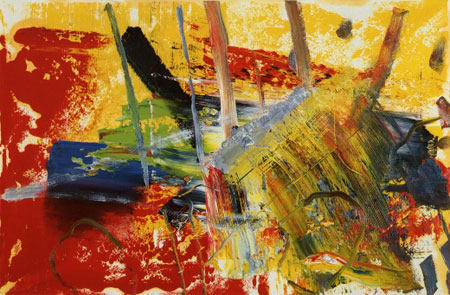
Gerhard Richter, 1985, 57.4 cm x 86.4 cm, Oil on paper
The Henri Art Magazine (written, I think, by several authors) has a fascinating continuation of a discussion of color, “Color: Simulation,” published on Wednesday Nov. 4, 2009.
The author discusses how the perception of color has changed with technology, the technology that presents any color you want: directly out of the can (reducing the need to use traditional techniques to create luminescence or brilliance by direct observation and experience); and then, further “enhancing” and changing color as we know it, technology can produce a pure physics of color through light technologies (as seen on the computer screen.) This, he insists, has produced color as desire, as consumer directed, and loses color as personal and emotive.
I can’t do justice to the writer’s observations; you’ll need to read them yourself. And I’m not sure the polemic need be as strong as it is.
But I was reminded of Steve’s black and white photography, (also here, on A&P) and along with thinking that Steve’s work clearly transcends point-and-shoot photography of the digitized masses, I suddenly understood how the black and white refuses the seduction of the digitized web versions of color.
Textile Art, Deserts, and Decisions
In a few months, I’ll be back in Nevada, tackling the Amargosa Playa again. This time I want to do a set of painted panels, five 5×5 foot ones (25 horizontal feet). I have various notions of how this might work out in paint, but will have to wait until I get there to see what actually happens. I also want to do something similar in textiles, perhaps only some preliminary image making, saving stitching for when I return to Portland. But I am mulling over both projects in my mind, trying to think how I might work them.
I just read a blog entry (dated August 17) by Jenny Bowker, who is an art colleague who works in quilted textiles. She tackled the same kind of landscape and had the same kind of hopes about what she might evoke, with some additions that the Amargosa doesn’t have: the presence of a handsome driver and some marvelous land forms. Her blog entry, which finishes with the photo of her textile work, is worth reading for sheer pleasure. But it makes me somewhat nervous about my ambitions.
Here’s the photo of Jenny’s artwork, which won a prize at the Canberra quilt exhibit and, I’m sure, will be seen often at other places around the globe.
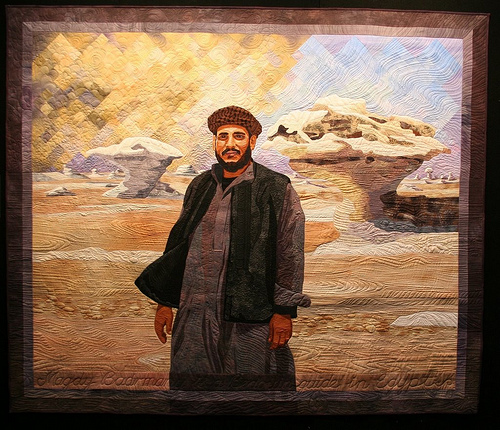
Jenny Bowker, Sandstorm over the White Desert, about life size (see her blog entry for scale)
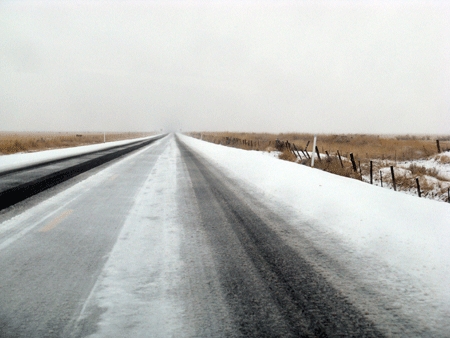
And here is an photo or two of what I will be facing, again